




Hexagon Loose Gemstones: Buyer Guide
Hexagon loose gemstones are faceted stones with six-sided outlines, sold without permanent jewelry settings. They can be cut from natural aquamarine, sapphire, spinel, garnet, topaz, citrine, tourmaline, and other gemstone varieties. Their distinctive appeal comes from the relationship between the outer geometry and the facets arranged inside it. A beautiful hexagonal gemstone should have an intentional, balanced outline, attractive color, properly finished facets, and proportions that allow light to return effectively through the crown.
The word hexagon describes the gemstone's outline, not a single cutting style or quality standard. Some stones have six nearly equal sides, while others use elongated or modified shapes. A cutter may arrange broad step facets around the perimeter, use brilliant-style facets for more frequent flashes, or develop an original design that produces a particular optical pattern. Two gemstones advertised under the same shape name can therefore look entirely different, even when their weights and face-up dimensions are similar.
When buying a hexagon gemstone loose, the principal advantage is the ability to evaluate the complete stone before a mounting conceals its edges and pavilion. The buyer can assess whether the corners are even, whether the table is centered, how much depth is carried below the girdle, and whether the reflections remain attractive from different viewing angles. These characteristics provide more useful evidence of quality than a cutting label or carat weight considered alone.

The difference between a hexagon shape and a hexagonal crystal
A hexagonal cut is a deliberate external shape produced by the gemstone cutter. A hexagonal crystal system describes the internal structure and symmetry of a mineral.
These are not the same thing.
Aquamarine and quartz belong to the hexagonal crystal system, and their rough crystals can sometimes display six-sided outlines. However, the natural crystal shape does not guarantee that a finished gem will have six equal sides or attractive optical proportions.
Sapphire is also associated with hexagonal crystallographic symmetry, but gem-quality sapphire is frequently cut into ovals, cushions, rounds, and other shapes according to its color and rough-crystal characteristics.
Spinel, garnet, and topaz belong to other crystal systems yet can still be cut into six-sided gemstones. The cutter creates the external geometry regardless of whether it resembles the mineral's natural crystal habit.
This distinction matters because a seller's description of a hexagonal gemstone does not independently establish mineral identity, natural origin, or quality. Those characteristics must be evaluated through accurate product information and, when appropriate, gemological examination.
The finished outline should be considered a cutting decision, not proof of how the original crystal formed.
Not every hexagon is a regular hexagon
A regular hexagon has six equal sides and six equal interior angles. Its geometry creates a recognizable pattern in which the corners and flat edges are evenly distributed.
Many faceted gemstones use modified versions of this outline. Some are elongated, while others have alternating long and short sides that create a shield-like or architectural appearance.
An elongated hexagon may be aesthetically successful when the sides and facet pattern look balanced. It should not automatically be treated as inferior to a regular hexagon.
The key is whether the finished shape looks deliberate.
A gemstone with one noticeably shorter edge may appear awkward when viewed directly from above, particularly if the discrepancy is not reflected elsewhere in the design. A deliberately elongated six-sided gemstone, by contrast, may have excellent visual balance even when the sides differ in length.
The table should also relate appropriately to the perimeter. If the crown facets are noticeably broader on one side, the table may look displaced from the center, making an otherwise appealing gemstone seem uneven.
Buyers should consider the outline and the internal faceting together rather than applying a simple assumption that all six sides must always be equal.
Why length-to-width ratios can mislead with hexagons
A length-to-width ratio is useful for describing elongated gemstones, but it needs careful interpretation when the outline is hexagonal.
For a regular hexagon oriented with two opposite vertices at the widest points, the point-to-point measurement is greater than the flat-to-flat measurement.
Geometrically, a regular hexagon's point-to-point distance is approximately 1.155 times its flat-to-flat distance.
This means a perfectly regular hexagon does not necessarily have equal measurements along those two particular axes. Yet a product listing might report two nearly equal face-up dimensions because the seller measured the stone along different directions or used a different orientation.
A quoted ratio close to 1.00 therefore does not, by itself, prove or disprove that a gemstone is a regular hexagon.
The meaningful questions are how the dimensions were taken and whether the shape looks balanced face-up.
For an unusual six-sided stone, a clear photograph with a millimeter scale or a properly labeled measurement diagram may be more informative than a simple pair of numbers.
The depth should be reported separately because it has a different purpose: it helps establish cutting proportions and, when relevant, the space required for a setting.
What real hexagonal gemstones reveal about size and price
Individual gemstone listings demonstrate how different a six-sided stone can look depending on its mineral species, weight, proportions, and color.
The following examples were verified against Gandhara Gems product pages on November 22, 2026.
| Natural gemstone | Weight | Published dimensions | Listed price |
|---|---|---|---|
| Deep-yellow Brazilian citrine | 8.60 ct | 12.4 × 12.3 × 9.6 mm | $205 |
| African orange citrine | 18.57 ct | 16.3 × 16.2 × 12.1 mm | $285 |
| Swiss-blue topaz, African origin listed | 20.95 ct | Four dimensions published; 14.90 × 14.70 × 14.55 × 12.22 mm | $490 |
| Seafoam aquamarine, Pakistan | 4.00 ct | 10.2 × 10.1 × 7.1 mm | $320 — sold out when checked |
The values describe specific retail listings, not standard market prices for each mineral species. Availability may change, and the four measurements shown for the topaz should not be interpreted as a conventional length-width-depth sequence without clarification.
Several useful comparisons emerge. The two citrines differ substantially in weight and physical size, yet their prices do not rise in direct proportion to their carat weights. The aquamarine is considerably smaller than the citrine examples but has a higher listed price than the 8.60-carat citrine.
Those differences reflect the characteristics and commercial markets of the individual gemstones, not simply the difficulty of creating a six-sided outline.
The buyer should also notice that the actual depth varies considerably. A large hexagon can be impressive when viewed from above while requiring a substantial amount of space beneath the girdle.
For collecting, that depth may be entirely acceptable. For jewelry, it can materially influence setting possibilities.
Facet arrangements: Geometry inside the six-sided outline
The internal facets determine how a hexagonal gemstone interacts with light.
A step-faceted hexagon generally uses broad surfaces arranged in layers that follow the outer outline. The reflections can appear structured and architectural, emphasizing transparency and orderly geometry.
A brilliant-style hexagon uses facet arrangements intended to produce more numerous flashes. Depending on the design, the result may look lively and intricate, with reflections changing as the gemstone is tilted.
Some designer cuts combine multiple approaches. A cutter might use a particular pavilion geometry to improve brightness while giving the crown an unusual pattern that complements the six-sided silhouette.
The gemstone's mineral species matters because refractive index influences which facet angles produce desirable light return.
A design optimized for quartz will not necessarily work equally well in garnet or sapphire. The same external outline can conceal very different pavilion arrangements.
Precision also matters, but accuracy alone does not guarantee beauty. A precisely executed design can still produce unattractive darkness or weak color when the proportions are unsuitable for the material.
A buyer should judge whether the facet pattern actually enhances the gem's appearance, not whether the design sounds unusually complicated.
How to examine facet symmetry
The six-sided outline provides a useful reference for judging the symmetry of the internal facets.
When the design is intended to be symmetrical, corresponding crown facets should appear reasonably consistent on opposite sides. The table should be appropriately centered, and the facet junctions should form an organized pattern.
A table noticeably displaced toward one corner may make the reflection pattern uneven. Facets that terminate at different positions can also create a less refined appearance.
However, a designer may intentionally use different facet arrangements to create a particular visual effect. In that case, the relevant question is whether the result appears coherent rather than whether it follows conventional symmetry.
High-quality polish is important because clean surfaces allow reflections to remain crisp. Fine scratches, polishing lines, or slightly rounded facet junctions may become visible under magnification.
These imperfections should be judged according to their effect on ordinary viewing. A minor polishing mark that does not affect the gemstone's appearance is different from poor finishing that makes an expensive designer cut look visibly blurred.
Price differences attributed to precision versus commercial gemstone cutting should be supported by improvements in visible workmanship or optical performance rather than the cutting label alone.
When a hexagonal gemstone looks transparent through the middle
A noticeable transparent region in the center of a faceted gem is commonly called windowing.
Windowing occurs when the cutting arrangement allows light to pass through an area instead of directing enough light back toward the viewer.
In a hexagonal gemstone, the effect may be particularly obvious when the center contrasts sharply with the surrounding facets.
A pale aquamarine with an extensive central window can appear nearly colorless through the table. An orange citrine may display a weak central region even though its edges remain richly colored.
A shallow pavilion can contribute to windowing, but the ideal cutting angles depend on the mineral's refractive properties and the overall design.
Some artistic gemstones deliberately incorporate transparent areas. Such effects should be distinguished from accidental windowing in a conventional design intended to produce strong light return.
The buyer should inspect the stone over different backgrounds and, where possible, observe it moving under neutral light. A single studio photograph may not reveal how much of the center remains transparent during ordinary viewing.
The important distinction is whether the window contributes to an intentional visual design or makes an otherwise attractive gemstone appear poorly proportioned.
Darkness can be part of an attractive reflection pattern
Not every dark facet is a problem.
A well-faceted gemstone often requires contrast between bright and dark reflections to create visual depth. As the stone moves, these regions should change in a way that contributes to its appearance.
The concern is excessive extinction, where large areas remain persistently dark and conceal the gemstone's color.
This can become significant in deeply colored sapphire, garnet, or tourmaline. A hexagonal gemstone may have beautiful geometric symmetry but appear dull if much of its pavilion fails to return useful light.
A darker gemstone can also look very different under strong studio illumination and ordinary indoor lighting. The buyer should avoid assuming that dramatic photographs establish consistent brightness.
A rotating video can reveal whether the central facets become bright at different angles or whether darkness remains dominant.
The strongest result combines pleasing contrast with enough light return to display the gemstone's natural hue across the face.
Choosing aquamarine for transparency rather than maximum darkness
Aquamarine can be particularly attractive in a hexagonal design because fine faceted specimens often have good transparency and an elegant blue or greenish-blue appearance.
The relatively pale color of some aquamarines creates a specific cutting challenge. If the pavilion is too shallow, windowing can reduce the apparent saturation, leaving the central facets looking weak.
Additional depth may improve the visual effect in some stones, but excessive depth can preserve unnecessary weight or create an inconveniently tall gemstone.
A 4.00-carat seafoam aquamarine from Pakistan, listed with a custom precision hexagon cut, measures 10.2 × 10.1 × 7.1 mm. Its pale blue-green color, published VVS clarity description, and dimensions illustrate the attributes that should be examined when comparing this variety. The individual gemstone was sold out when checked, so the specifications serve as a useful real-world comparison rather than a current purchasing opportunity.
Transparency is appealing, but it should not be confused with complete freedom from inclusions. Internal features must still be considered according to their position and impact on beauty.
For aquamarine, the strongest hexagon is one whose faceting creates enough brightness and contrast to support its natural color.
Citrine: Size and geometry at accessible price levels
Citrine provides opportunities for substantial hexagonal gemstones because naturally formed quartz can be cut into relatively large, transparent stones.
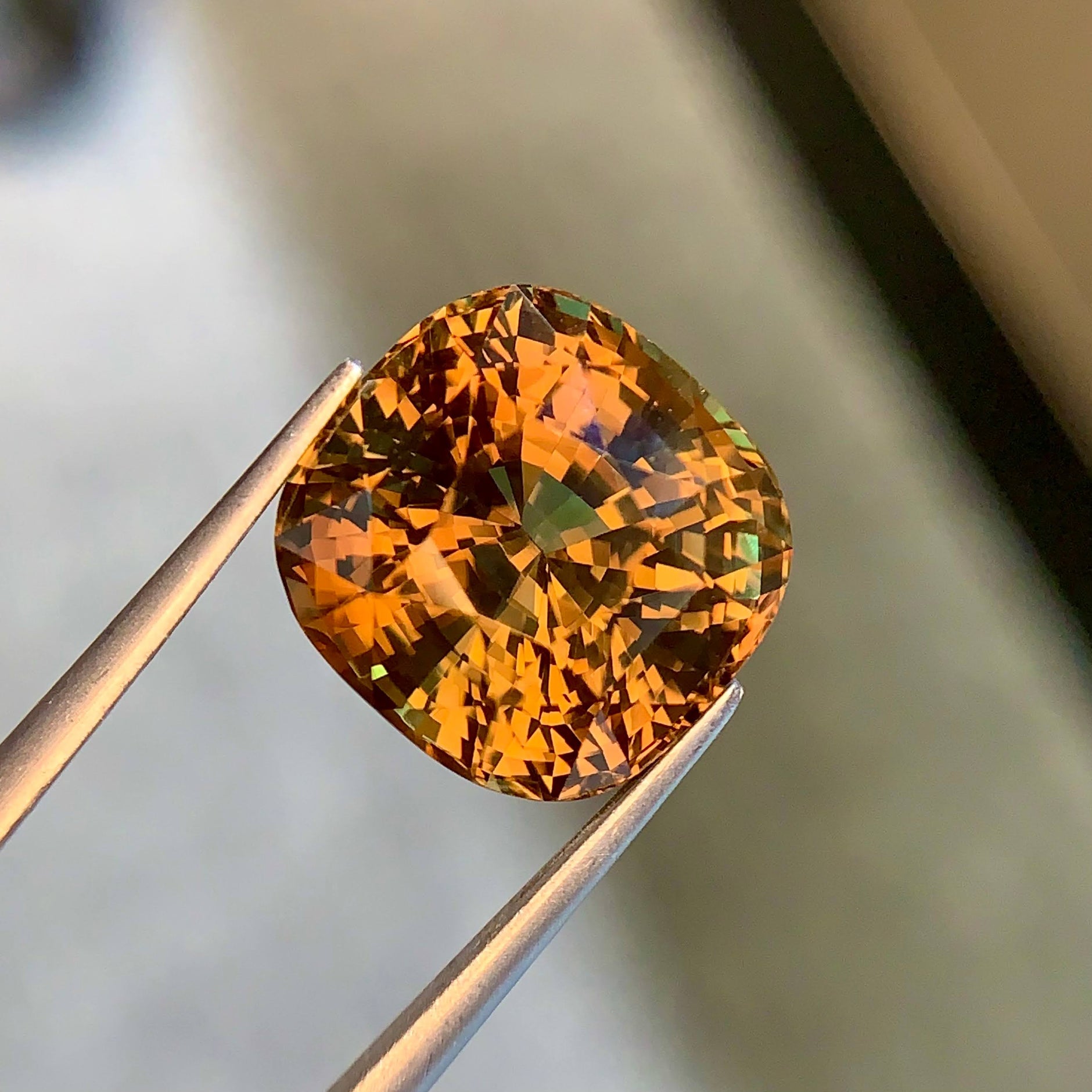
The 8.60-carat deep-yellow Brazilian citrine is listed with a hexagonal cut, loupe-clean clarity, dimensions of 12.4 × 12.3 × 9.6 mm, and no treatment stated. Its golden color and substantial depth make it an interesting example for buyers comparing color, geometry, and visible size.
The depth is especially relevant. More material below the girdle can increase carat weight, but it does not necessarily make the stone appear proportionately larger from above.
Citrine has a Mohs hardness of 7, so it is more vulnerable to scratching than sapphire or spinel. Its physical characteristics may be entirely suitable for a protected pendant or carefully worn piece, while a demanding everyday ring presents different considerations.
Treatment disclosure deserves attention because commercial citrine can be naturally colored or produced through heating other naturally formed quartz varieties. The listing's stated treatment information should be considered alongside the available supporting documentation.
The visual value of a large citrine depends on whether the cutting produces attractive reflections and maintains a pleasing golden color, not simply on the impressive carat number.
Blue topaz: When substantial size brings practical tradeoffs
Blue topaz can produce striking hexagonal gemstones, particularly when the buyer values bright blue color and a large geometric outline.
The 20.95-carat Swiss-blue hexagonal topaz is advertised at $490 with loupe-clean clarity and standard treatment disclosed. Its size is considerably greater than many gemstones chosen for everyday rings, making depth and mounting requirements important considerations.
Topaz has a Mohs hardness of 8, providing good resistance to scratching, but it also has perfect cleavage. This means that certain impacts or setting pressures can cause breakage despite the comparatively high hardness.
A large geometric stone with exposed edges should therefore be handled and mounted carefully. The buyer should establish whether a qualified jeweler can accommodate the actual shape and depth without placing harmful pressure on the gemstone.
Color treatment is another consideration. Much of the commercial Swiss-blue topaz market consists of naturally formed topaz whose color has been produced through irradiation and heating. The individual treatment disclosure should be understood rather than assuming that natural topaz must be untreated.
For a statement pendant or collection, a large hexagonal topaz can provide substantial visual presence. Its suitability for frequent ring wear requires a different assessment because of cleavage and the stone's physical dimensions.
Does a larger hexagon offer better value?
Not automatically.
A gemstone's carat weight measures mass, while its face-up dimensions establish the visible area. Mineral density, cutting depth, and the original rough shape all influence how the two relate.
A deep gemstone can retain considerable weight beneath the girdle without creating a larger visual outline. Conversely, a broad shallow stone may look impressive in photographs but suffer from extensive windowing.
The comparison becomes more complicated across different species. Topaz, citrine, aquamarine, sapphire, and garnet have different densities and commercial values.
A large hexagonal citrine may have a considerably lower price per carat than a smaller fine sapphire, but that difference is not evidence that one gemstone is objectively better cut or more desirable.
Color, transparency, treatment status, and cutting quality must be considered within the appropriate mineral category.
A smaller stone with excellent symmetry and light return can be the stronger purchase when a larger example contains substantial hidden weight or has weak optical performance.
Clarity and the location of inclusions
The importance of an inclusion depends on its type, position, and effect on the gemstone's appearance or durability.
Some hexagonal designs have broad facets that make internal features easier to see. Others use intricate brilliant-style faceting that can make minor inclusions less conspicuous.
A small enclosed crystal near the edge may have little impact on ordinary viewing. A conspicuous feature directly beneath the table can interrupt the pattern, especially when the gemstone is otherwise transparent.
Surface-reaching fractures require separate attention because they may influence physical stability and future setting requirements.
Clarity expectations also vary by gemstone species. Fine aquamarine and topaz are often available with attractive transparency, while other minerals or varieties may have different inclusion characteristics.
Terms such as VVS, VS, SI, and loupe-clean can be useful descriptions, but they are not applied through one universal independent colored-gemstone grading system.
A buyer should examine the actual stone under realistic lighting rather than relying entirely on a seller's clarity label.
A sound hexagon should have carefully finished corners
The corners are a distinctive feature of a six-sided gemstone, and their physical condition should be evaluated before purchase.
Sharp corners can be attractive, but thin girdle areas may be more vulnerable to chipping, particularly when the stone is handled or mounted.
A gemstone with minor intentional corner modifications may be more practical than one whose points are excessively thin. However, uneven corner trimming can also detract from a design intended to be symmetrical.
The girdle should be inspected for chips, fractures, and significant irregularities. A very thick girdle may preserve weight without improving the face-up appearance, while an extremely thin one may increase vulnerability.
The appropriate condition depends on the intended use. A stone selected for collecting can be stored and handled differently from one that will be fitted into a ring or pendant.
For jewelry, a qualified jeweler should examine the loose stone before manufacturing begins, especially when the cut has unusual proportions or a complex pavilion.
Natural origin, locality, and treatment are separate questions
The appearance of a hexagonal gemstone cannot establish whether it formed naturally or received treatment.
A natural blue topaz may have been irradiated and heated. Citrine may also be naturally colored or produced through heat treatment, while sapphire and other varieties have their own enhancement possibilities.
The geographic locality stated in a commercial listing should be evaluated separately from natural identity and treatment status.
For valuable gemstones, an independent laboratory report may be useful when a specific origin or untreated claim materially influences the asking price.
A report can help establish mineral identity and certain detectable treatments, but it does not automatically establish attractive cutting or fair market value.
Buyers should also distinguish the cut shape from natural crystallography. A regular hexagonal outline is not proof that the gemstone belongs to a particular mineral species or that the original crystal was naturally six-sided.
Accurate disclosure and an appealing individual stone are complementary requirements, not substitutes for each other.
What to establish before making the purchase
A sound purchasing decision should begin with the actual face-up appearance. The gemstone should have balanced geometry, attractive color, and reflections that remain pleasing when it moves.
The published measurements should then be examined carefully. For an unusual hexagon, the buyer may need clarification about which axes were measured, particularly when the seller reports more than three dimensions or the outline is elongated.
Clarity, treatment disclosure, locality information, and any laboratory documentation should correspond to the specific stone being offered.
Photographs should show the actual gemstone from the front and enough additional angles to evaluate its depth, corners, and girdle.
If the buyer intends to commission jewelry, the jeweler should review the dimensions and physical condition before the gemstone is altered or permanently mounted.
A stone with beautiful color but weak cutting may still be appealing at an appropriate price, while a precisely fashioned gemstone deserves closer attention to whether its craftsmanship produces a meaningful visual advantage.
The strongest purchase is the one whose quality, price, and intended use remain consistent when every characteristic is considered together.
Conclusion
Hexagon loose gemstones offer a distinctive combination of six-sided geometry, varied facet designs, and natural color. Their beauty depends on symmetry, optical performance, polish, depth, and the physical characteristics of the underlying mineral. Large aquamarine, citrine, and topaz examples demonstrate how different gemstones can share the same general outline while offering completely different visual and commercial qualities.
When choosing an individual stone, prioritize balanced faceting, attractive face-up color, suitable dimensions, and accurate disclosures rather than the shape name or carat weight alone. A considered selection from Gandhara Gems' natural loose gemstones can provide the right six-sided centerpiece for custom jewelry or a personal gemstone collection.
Frequently Asked Questions
What is a hexagon-cut loose gemstone?
A hexagon-cut loose gemstone is an unset faceted stone with six sides when viewed from above. The outline may be regular, elongated, or modified, while the internal facets can use step, brilliant, mixed, or designer arrangements. The term describes the finished shape rather than mineral identity or cutting quality. Aquamarine, sapphire, spinel, garnet, topaz, citrine, and other minerals can all be fashioned into hexagons. Buyers should examine the actual outline and facet pattern rather than assume every hexagonal stone follows one standardized design.
Does a hexagonal gemstone have six equal sides?
Not necessarily. A regular hexagon has six equal sides and angles, but faceted gemstones may have elongated or modified six-sided outlines. These variations can be intentional responses to the original rough crystal or part of an artistic cutting design. An elongated hexagon can be attractive when its geometry looks balanced, while an irregularly cut stone may appear awkward if the differences are unintended. A face-up photograph is more informative than the word hexagon alone when deciding whether the actual shape is appealing.
Why might a regular hexagon have different length and width measurements?
A regular hexagon has different point-to-point and flat-to-flat distances. When measured across opposite vertices and opposite sides, the longer distance is approximately 1.155 times the shorter distance. A seller may use other measurement axes, particularly when the stone is rotated or the outline has been modified. Consequently, a length-to-width ratio near 1.00 does not automatically establish whether a gemstone is geometrically regular. The axes need to be understood before the measurements can be interpreted accurately.
Are precision-cut hexagons more valuable than commercial cuts?
They can command a premium when accurate facet placement, refined polish, balanced symmetry, or an unusual optical design create visible improvements. However, precision cut is not a universal guarantee of beauty. A commercially cut gemstone can have attractive color, good symmetry, and strong light return, while a poorly planned precision design may display windowing or excessive darkness. Mineral species, color, rarity, clarity, and treatment information also influence value. Buyers should judge the finished appearance rather than assume that a particular cutting label establishes superior quality.
Why do some hexagon gemstones look transparent in the center?
A transparent-looking central region may be caused by windowing, where the pavilion allows light to pass through instead of returning enough light toward the viewer. The effect can become noticeable in pale aquamarine, citrine, and other transparent gems. Shallow cutting proportions may contribute, although the appropriate angles depend on the mineral's optical properties. Some artistic designs intentionally incorporate transparent areas. For conventional faceted hexagons, a large unwanted window may reduce the apparent color and brilliance.
Is a large hexagonal topaz worth buying?
A large topaz may be appealing when its color, transparency, cutting, and price suit the buyer's purpose. Topaz can offer substantial dimensions at a lower cost than many fine sapphires or spinels, but its perfect cleavage deserves attention. A large gemstone may also require a specialized mounting because of its depth and outline. For a protected pendant or collection, these characteristics may be acceptable. The buyer should compare actual face-up size, treatment disclosure, clarity, and physical condition rather than assuming greater carat weight automatically provides better value.
Can a hexagon cut prove that a gemstone is natural?
No. The external outline is created through cutting and polishing and does not establish whether the gemstone formed naturally. Laboratory-grown stones can also be faceted into hexagonal shapes, and naturally formed gemstones may receive treatments. Even the mineral's crystal system cannot be established reliably from the finished outline alone. Natural identity, species, treatments, and important locality claims require accurate disclosure and, where appropriate, gemological testing. The cut should be evaluated separately for beauty, symmetry, and workmanship.
Should I buy a hexagonal gemstone before choosing the jewelry setting?
The intended jewelry design should be considered before purchase, but the final mounting is usually best made or fitted after the actual gemstone has been selected. Hexagons vary in side lengths, corner geometry, girdle thickness, and pavilion depth, so stones with similar carat weights may require different settings. A jeweler should confirm that the selected gem can be secured without damaging vulnerable areas. This is particularly important for large, deep, brittle, or cleavage-sensitive gemstones whose physical characteristics limit the available mounting options.


