

-
Luminous Double Terminated Green Epidote Crystal Spacemen from Pakistan - Green
This is an impressive stacking of multiple tabular crystals of Epidote with primary dark green color to secondary vivid forest green color. It's a complete floater with double terminated crystal form, well crystalized all around and compact crystal quality. It has magnificent metallic luster...- $110.00
- $110.00
- Unit price
- per
-
Green
-
Impressive Double Terminated Epidote Crystal with Albite from Skardu, Pakistan - Black
This is an interesting elongated doubley terminated Epidote crystal with secondary crystals shooting out of primary crystal. It has magnificent metallic luster, well crystalized all around with 360-degree view and compact crystal form. It has perfect pointed termination with fine sharp crystal faces. ...- $100.00
- $100.00
- Unit price
- per
-
Black
-
Bring Nature's Harmony into Your Life with Green Epidote Mineral from Pakistan - Green
This is colorful and attractive example for Epidote with saturated forest green coloration. It has more a tabular crystal form with compact crystal quality and showing great crystal quality. Its well crystalized all around with 360-degree view with fine edges. Product Information: Specimen...- $100.00
- $100.00
- Unit price
- per
-
Green
Free Shipping on order over $80
100% Authentic & Certified
Save Big in 2026
Epidote Minerals
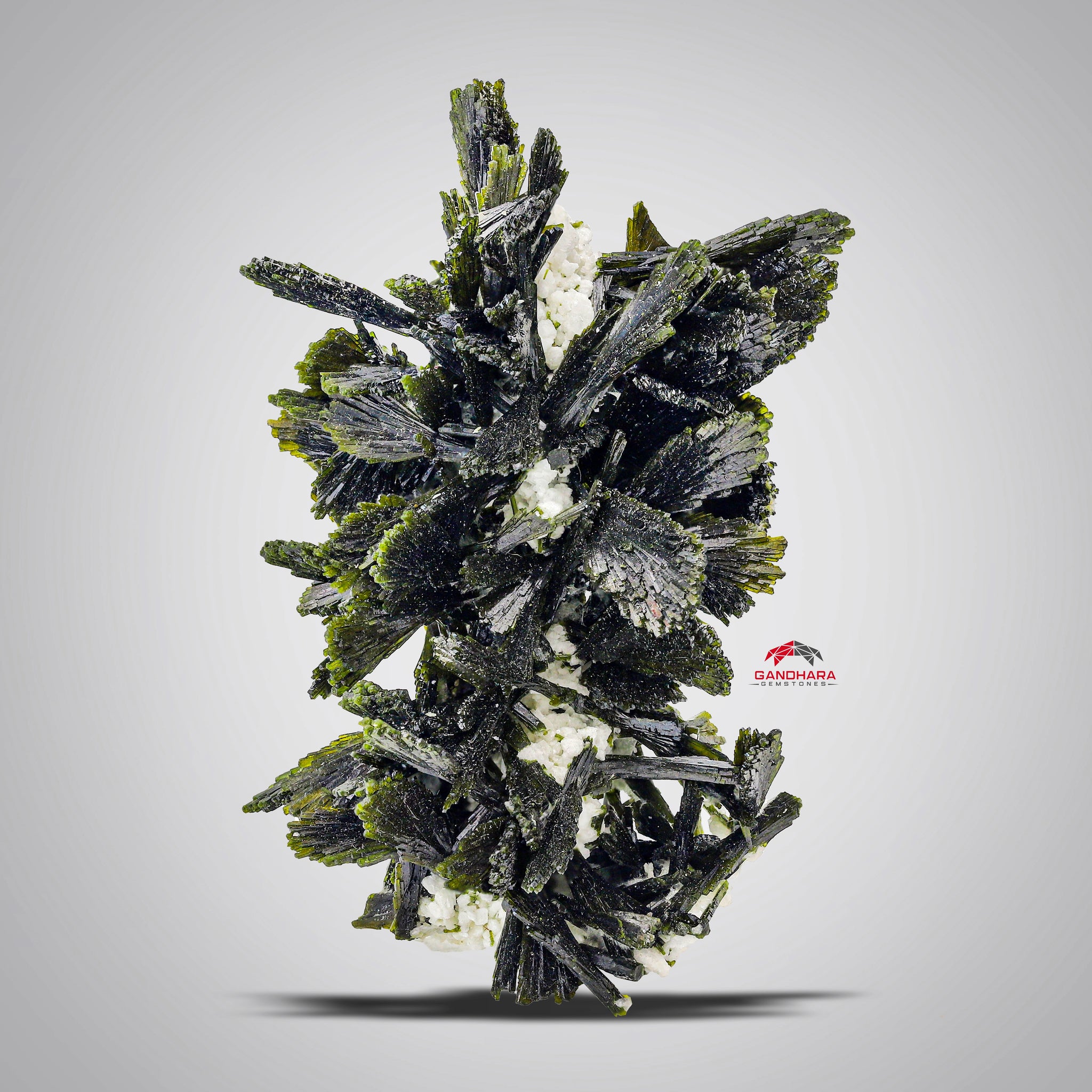
Epidote mineral specimens are best selected by comparing natural crystal form, dark green to near-black appearance, surface luster, matrix association, dimensions and visible condition rather than simply choosing the darkest or heaviest piece. Epidote commonly forms elongated or prismatic crystals and can range from characteristic yellowish or pistachio green through deeper olive, brownish green and colors that appear almost black in thick crystals. For collectors, the strongest specimen is usually the one whose natural morphology, surfaces and relationship with its host rock create an appealing and well-preserved composition.
Sidebar


Epidote belongs to a mineral group rather than functioning primarily as a conventional transparent jewelry gemstone in this collection. Individual specimens may contain sharply developed crystals, dense clusters, partial crystals or crystals embedded in matrix. Transparency can range from relatively transparent at thin edges to translucent or effectively opaque in thicker dark pieces. Those differences mean specimen quality should be judged by what the mineral naturally displays rather than by applying faceted-gemstone standards such as eye-clean clarity or brilliance.
Epidote Crystal Form: How Prismatic Growth and Natural Striations Affect Collector Appeal
Epidote crystallizes in the monoclinic crystal system and can develop elongated, prismatic or bladed crystals. Well-formed examples may show pronounced longitudinal striations along crystal faces, creating an immediately recognizable surface texture that becomes especially apparent under directional light.
For specimen collectors, crystal definition often matters more than sheer size. A compact piece with clearly developed faces, sharp edges and an intact termination can reveal the mineral's structure more effectively than a much larger specimen consisting mainly of massive or broken material. Groups of parallel or intersecting epidote crystals can also create visually complex specimens where the overall arrangement becomes just as important as the condition of any single crystal.
Natural surface textures should not automatically be mistaken for damage. Growth markings, contact areas and irregularities can record how the crystal formed or interacted with neighboring minerals. Fresh chips are different because they interrupt the original morphology. When comparing pieces online, inspect prominent crystal tips and edges closely while also appreciating natural growth features that give each specimen its individual character.
The wider mineral specimens and crystals selection provides useful context for comparing epidote's elongated monoclinic forms with minerals that develop very different crystal habits.
Epidote Color: Why Dark Green and Near-Black Crystals Can Reveal More Under Light
Epidote is strongly associated with green, particularly yellow-green, pistachio-green and olive tones, although iron-rich and thick crystals may appear dark brownish green or nearly black in ordinary viewing conditions. That apparent darkness should not be interpreted as a separate guarantee of quality. Thin edges or strongly illuminated sections can sometimes reveal green or brown-green color that is not obvious through the thicker body of the crystal.
Luster and surface condition can strongly affect how dark epidote looks. A well-formed crystal with vitreous faces may reflect enough light to show its geometry clearly even when the body color is very deep. A specimen with dull or heavily damaged surfaces can appear visually flatter even if its underlying color is similar.
Collectors should therefore consider color together with crystal thickness, luster and matrix contrast. A dark epidote crystal on a pale matrix can create a dramatic specimen, while a lighter green transparent edge may add another level of visual interest. The darkest example is not automatically preferable if another piece shows better form, preservation or composition.
Epidote Luster and Surface Quality: What to Examine on Natural Crystal Faces
Epidote generally shows a vitreous luster on fresh crystal faces, and this surface reflection can make a substantial difference to specimen appearance. Strongly defined faces catch light in distinct planes, helping the eye read the shape of elongated or bladed crystals even when the color is very dark.
Surface quality should be judged realistically. A natural mineral specimen does not need mirror-like faces throughout, and some crystals may show growth textures, partial coatings or contact surfaces from other minerals. These can be authentic features of formation. More consequential damage includes broken terminations, chipped focal edges or abrasion that removes significant portions of the main crystal surfaces.
The importance of a damaged area also depends on where it occurs. A minor chip hidden at the back of the specimen may have little effect on display, while damage to the primary crystal termination can change the visual character substantially. Buyers should therefore assess the strongest viewing side and the condition of the crystals that dominate that view.
Epidote Matrix Specimens: Evaluating Crystal Placement and Associated Minerals
Matrix can transform an epidote crystal from an isolated mineral into a geological composition. Host rock may provide visual contrast, stabilize a cluster and preserve relationships between epidote and associated minerals that developed together.
A strong matrix specimen often has clearly visible focal crystals rather than a large amount of rock with only minimal epidote exposed. Several small but sharply developed crystals can produce a more interesting piece than one larger crystal partially hidden within matrix. Color contrast is also important. Dark epidote can be particularly noticeable when it stands against a lighter host.
Physical stability deserves attention as well. Projecting crystals attached at narrow points can be vulnerable even if the epidote itself has respectable hardness. Associated minerals may be softer or structurally weaker, which means the durability of the complete specimen depends on more than epidote alone.
When buying for display, examine whether the specimen appears to have a stable resting position or whether a stand may be needed to present the strongest face safely.
Epidote Specimen Size vs Crystal Quality: Why Dimensions Matter More Than Weight Alone
Large mineral specimens can have strong display presence, but size should not overshadow crystal quality. A smaller epidote with an intact termination, strong natural luster and distinct crystal form can be more satisfying than a large piece dominated by matrix or broken crystals.
Length, width and height are generally the most useful measurements for understanding how a specimen will appear in a cabinet or display. Gross weight can be misleading because matrix may account for a considerable proportion of the mass. Dense host rock can make one specimen significantly heavier than another without giving it larger or better epidote crystals.
Buyers should therefore compare the actual dimensions of the focal crystals as well as the overall specimen. If cabinet space is limited, a compact piece with concentrated crystal quality can provide more visual impact per unit of display area than a broad matrix specimen.
Epidote Hardness, Cleavage and Safe Specimen Handling
Epidote generally has a Mohs hardness around 6 to 7, giving intact crystal surfaces reasonable resistance to scratching. Hardness does not mean a specimen is immune to breakage, however. Epidote has a well-developed cleavage direction, and long crystals or thin projections can be vulnerable to impact.
Handling should focus on the strongest part of the specimen, usually the stable matrix or base rather than exposed crystal tips. Lifting a specimen by an elongated crystal can create unnecessary leverage at the attachment point and may damage either the crystal or matrix.
Storage should also prevent pieces from knocking against one another. A projecting crystal can chip another specimen or be damaged itself if a collection drawer is moved abruptly. The general gemstone care guidance is useful for careful handling, while complex matrix pieces should always be treated according to the characteristics of every mineral present.
Epidote Mineral Identification: Why Near-Black Color Is Not Enough
Very dark epidote can visually overlap with many other minerals, so black or dark green color alone should never be considered definitive identification. Crystal habit, luster, hardness, cleavage and other mineralogical properties provide more useful evidence when considered together.
The name of a mineral specimen carries scientific meaning as well as aesthetic value. Buyers building a systematic collection should therefore preserve any accompanying identification and locality information rather than relying entirely on visual appearance after purchase.
Gandhara Gems' authenticity guarantee provides relevant purchasing context regarding mineral identity. When unusually significant specimens require higher-confidence analytical identification, appropriate mineralogical testing can go beyond what photography and basic observation can establish.
Epidote Origin and Provenance: Why Locality Should Be Supported by Documentation
Epidote occurs in multiple geological environments around the world and is commonly associated with metamorphic and hydrothermal processes. Crystal color or morphology may sometimes suggest similarities with known occurrences, but appearance is not reliable enough to establish geographic origin by itself.
Documented locality can add important geological context to a collection because it links the specimen to a specific occurrence. Collectors may organize epidote specimens according to locality, host rock or associated minerals, making reliable provenance part of the piece's scientific usefulness.
When locality information is not available, the correct approach is to judge the specimen by what can actually be observed rather than assigning an unsupported source. A well-formed epidote remains an attractive and educational mineral even without a famous locality attached to its description.
Buying Epidote Minerals Online: What to Check Before Ordering
Compare each epidote specimen by crystal definition, dark green to near-black color, natural luster, termination condition, matrix composition and physical dimensions. Study the strongest display crystals carefully for fresh chips or broken tips, but distinguish those defects from natural striations, growth surfaces and contact areas.
If the specimen includes substantial matrix, consider how much of the total composition is visually active epidote and whether the crystals appear securely attached. Actual length, width and height provide more practical information than weight when determining how the piece will fit within a collection.
Online buying also requires practical consideration of delivery and inspection. Gandhara Gems' shipping information explains applicable order conditions, while the return policy provides the relevant framework if a specimen needs to be returned.
Epidote Mineral FAQs
What color is natural epidote?
Epidote commonly appears yellow-green, pistachio-green, olive-green or brownish green. Thick and iron-rich crystals can look extremely dark or nearly black.
Is black-looking epidote actually black?
Some specimens appear almost black in normal lighting, although thin edges or strong transmitted light may reveal dark green or brownish-green tones.
What makes a good epidote mineral specimen?
Well-developed crystal form, intact terminations, attractive luster, interesting matrix, recognizable striations and good overall preservation can all contribute to collector appeal.
Is epidote a hard mineral?
Epidote typically has Mohs hardness around 6 to 7. It still requires careful handling because cleavage, crystal shape and fractures can make individual specimens vulnerable to impact.
Are surface lines on epidote crystals damage?
Not necessarily. Epidote crystals can display natural growth striations and textures. Fresh chips and broken edges should be distinguished from these original features.
Should I buy the heaviest epidote specimen?
Not automatically. Matrix can account for much of a specimen's weight. Crystal form, dimensions, condition and visual composition are usually more useful quality indicators.
Does geographic origin affect epidote collecting?
Reliable locality can add geological and collecting context. Origin should be documented rather than guessed from color or crystal shape.
Choose Epidote Minerals by Crystal Form, Luster and Natural Preservation
Compare the available epidote minerals by the definition of their crystals, dark green to near-black appearance, natural striations, luster, matrix relationship, actual dimensions and visible condition. Prioritize intact focal crystals and a balanced specimen composition rather than gross weight or darkness alone. Choose the individual epidote whose natural morphology and state of preservation best suit the collection or display you are building.

Recently Viewed Products
Example product title
- $19.99
- $19.99
- Unit price
- / per
Example product title
- $19.99
- $19.99
- Unit price
- / per
Example product title
- $19.99
- $19.99
- Unit price
- / per
Example product title
- $19.99
- $19.99
- Unit price
- / per
Example product title
- $19.99
- $19.99
- Unit price
- / per
Example product title
- $19.99
- $19.99
- Unit price
- / per
Example product title
- $19.99
- $19.99
- Unit price
- / per
Example product title
- $19.99
- $19.99
- Unit price
- / per
Example product title
- $19.99
- $19.99
- Unit price
- / per
Example product title
- $19.99
- $19.99
- Unit price
- / per
- Choosing a selection results in a full page refresh.


