

-
rare combination of gem Morganite with Pollucite and Tourmaline from Afghanistan - Pink
A captivating and rare marvel, the gem Morganite takes center stage in a mesmerizing composition alongside Pollucite and Tourmaline from the enchanting landscapes of Afghanistan. The delicate pink hues of Morganite, a variety of beryl, gracefully interplay with the ethereal translucence of Pollucite, creating...- $1,650.00
- $1,650.00
- Unit price
- per
-
Pink
-
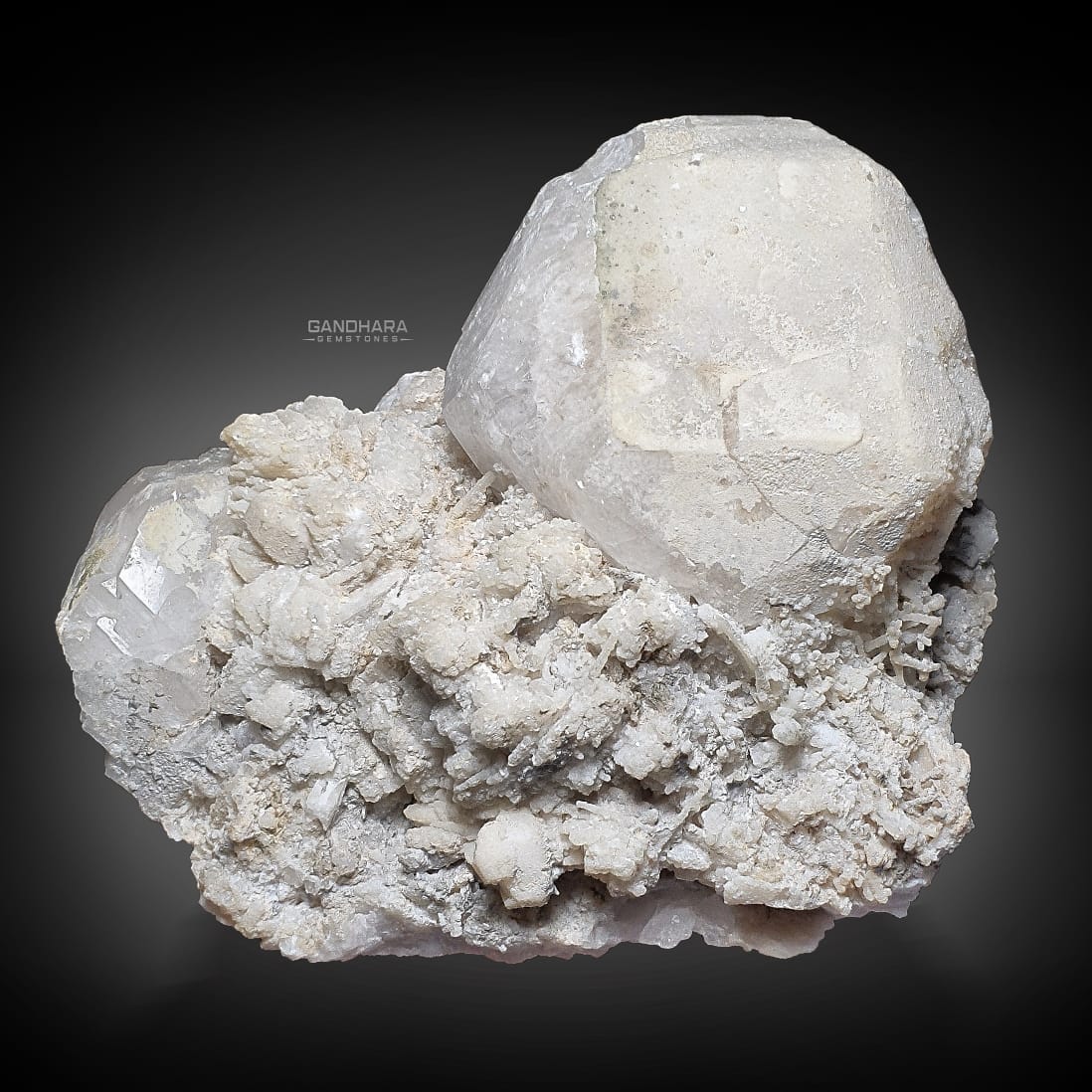
Interesting Naturally Etched Pollucite - White
Presenting this gorgeous naturally etched Pollucite with magnificent vitreous mirror luster and so well crystalized all around. It has excellent transparency with more 360-degree view all around. It has glassy faces with intersting crystallography and naturally etched formation. Its an indeed pretty neat and...- $150.00
- $150.00
- Unit price
- per
-
White
Free Shipping on order over $80
100% Authentic & Certified
Save Big in 2026
Pollucite Minerals
Pollucite minerals are best selected by comparing natural crystal development, colorless to white appearance, transparency, luster, associated pegmatite minerals, actual dimensions, provenance and visible preservation rather than by expecting every specimen to display dramatic external crystals. Pollucite is a cesium-rich aluminosilicate in the zeolite group, with sodium commonly substituting alongside cesium and water incorporated within its structure. It belongs primarily to the isometric crystal system and has Mohs hardness around 6.5 to 7, yet well-formed free crystals are uncommon because pollucite is frequently found as massive or irregular crystalline material within complex granitic pegmatites.
Sidebar


That habit makes pollucite different from collector minerals whose identity is immediately obvious from brightly colored prisms or geometric cubes. A strong specimen may instead preserve a pale translucent mass associated with albite, quartz, petalite, lepidolite, tourmaline or other pegmatite minerals, with its value lying in rarity, mineralogical context and reliable identification. Buyers comparing pollucite with other mineral specimens and crystals should therefore focus on what the specimen actually preserves rather than judging it by color intensity or dramatic crystal shape alone.
Pollucite Color and Transparency: Why Pale Specimens Can Still Be Distinctive
Pollucite is most commonly colorless or white, although pale gray, faint pink, light blue and pale violet appearances can occur. Transparent to translucent material can have a glassy appearance, while more massive specimens may look somewhat waxy, greasy or resinous depending on surface condition and internal texture.
Because the mineral is usually pale, lighting has a significant effect on how much internal detail becomes visible. Strong transmitted light can reveal transparent areas, inclusions and subtle color that remain hidden under ordinary cabinet lighting, while reflected light emphasizes surface luster and fracture texture.
A completely colorless specimen is not automatically less desirable than a lightly colored example. For collectors, well-documented locality, unusual transparency, preserved crystal faces and association with other pegmatite minerals may contribute more mineralogical interest than a faint body color.
Pollucite Crystal Form: Why Well-Formed Crystals Are Relatively Uncommon
Pollucite is structurally associated with the isometric system, yet natural specimens are much more often massive than sharply crystallized. Rare crystals may show cubic or trapezohedral forms or combinations of these shapes, but collectors should not expect every authentic specimen to present obvious geometric faces.
This distinction matters when evaluating photographs. An irregular pale mass with reliable identification can represent perfectly normal pollucite, while an unusually sharp crystal may be especially interesting precisely because such morphology is less common.
When recognizable faces are present, their preservation deserves careful attention. Natural contact areas formed against neighboring pegmatite minerals should be distinguished from later chips, and a specimen with only a few surviving original surfaces can still be valuable if those surfaces reveal the mineral's natural development clearly.
Pollucite in Cesium-Rich Pegmatites: Geological Context Matters
Pollucite is strongly associated with highly evolved granitic pegmatites enriched in lithium, cesium and tantalum. These environments can produce complex mineral assemblages containing petalite, spodumene, lepidolite, albite, quartz, tourmaline and several rarer species.
For a collector, those associations can make matrix specimens more informative than isolated fragments. Pollucite next to albite or another characteristic pegmatite mineral preserves part of the geological setting in which cesium became concentrated enough for the mineral to form.
Matrix should still be assessed for stability. A pale pollucite mass may be physically sound while associated mica or fractured feldspar is much more delicate, so the complete specimen should be supported from its strongest portion rather than by projecting attached minerals.
Pollucite and Cesium: Why Chemistry Makes the Mineral Important
Pollucite is one of the most important naturally occurring cesium-bearing minerals. Cesium occupies structural sites together with sodium, producing a mineral whose chemistry is unusual even when its appearance is visually understated.
This chemical significance explains why pollucite attracts systematic mineral collectors who may value a specimen for elemental composition and geological rarity rather than for dramatic color. A nearly colorless specimen can therefore hold substantial scientific interest because of what its crystal structure contains.
Collector specimens should remain distinct from industrial discussions about cesium extraction. The buying decision here concerns natural mineral form, association, provenance and preservation rather than commodity value or assumptions about how much extractable cesium a particular hand specimen contains.
Pollucite Hardness and Brittleness: Why It Can Break Despite Good Scratch Resistance
Pollucite has Mohs hardness around 6.5 to 7, placing it close to quartz in scratch resistance. The mineral is nevertheless notably brittle, so a compact piece can fracture or chip when dropped even though its surfaces resist ordinary abrasion reasonably well.
This difference between hardness and toughness is important for collectors. A transparent edge may look solid but can break if pressure reaches an existing internal fracture, while a massive specimen with irregular surfaces may contain hidden weaknesses from natural pegmatite breakage.
Stable cabinet storage is more appropriate than frequent handling. The practical principles under gemstone care provide a useful foundation, with particular attention paid to avoiding drops, hard impacts and abrasive contact with neighboring specimens.
Pollucite Fracture and Surface Texture: Understanding Irregular Natural Breaks
Pollucite typically lacks prominent cleavage and commonly breaks with irregular, uneven or partly conchoidal fracture. This can produce surfaces that look somewhat quartz-like, especially in transparent or translucent fragments.
Fresh fractures may appear brighter and glassier than naturally weathered exterior surfaces. They can expose attractive transparency, but they also indicate that the specimen no longer preserves natural crystal boundaries in those areas.
For collectors, a broken surface is not necessarily a reason to reject pollucite because massive occurrences commonly require extraction from pegmatite host rock. The important question is whether enough natural texture, matrix or crystal form remains to make the specimen informative and visually coherent.
Pollucite vs Quartz and Feldspar: Pale Pegmatite Minerals Can Be Confusing
Colorless or white pollucite can resemble quartz, albite and other pale pegmatite minerals in photographs, particularly when no distinctive crystal form is present. Transparent fragments can be especially difficult to identify reliably by appearance alone.
Hardness, density, refractive behavior, crystal structure and chemical analysis provide stronger evidence than color. Geological context can support an identification but should not replace mineralogical confirmation, because several visually similar species can occur together in the same pegmatite.
Gandhara Gems' authenticity guarantee provides relevant purchasing context where mineral identity matters. Serious systematic collectors may also value analytical confirmation for unusual specimens whose morphology offers few visual diagnostic features.
Pollucite and Analcime: Structurally Related but Chemically Distinct
Pollucite is structurally related to analcime and belongs to the same general zeolitic framework family. Cesium is a major distinguishing component of pollucite, whereas analcime is primarily sodium-bearing.
This relationship is useful mineralogically because it shows how closely related framework structures can accommodate different large alkali elements. It also reinforces why visual appearance alone may not provide precise identification, since pale isometric zeolitic minerals can overlap superficially.
For collectors interested in mineral chemistry, pollucite offers a particularly clear example of how unusual elemental concentration within pegmatites produces species that may look simple externally but are compositionally distinctive.
Pollucite Mineral Specimens vs Pollucite Rough
Pollucite can also appear as rough pieces intended for cutting, study or lapidary experimentation when transparency and internal cleanliness are sufficient. That intention differs from a specimen whose natural form, matrix and provenance are the main reasons to preserve it intact.
Collectors interested in unworked material for cutting can compare pollucite rough gemstones, while a complete mineral specimen should be assessed for its natural morphology and geological context before anyone considers removing its original surfaces.
A well-associated or unusually crystallized pollucite may lose much of its collector significance if faceted. Broken transparent material with little surviving natural form presents a different decision and can be evaluated according to internal clarity instead.
Pollucite Provenance: Why Pegmatite Locality Adds Scientific Value
Pollucite is known from evolved pegmatites in several parts of the world, and documented locality can add substantial scientific value because individual deposits differ in mineral associations and chemical evolution.
Appearance alone should never be used to assign a famous pegmatite source. Colorless or white pollucite from separate regions can look nearly identical, particularly once removed from diagnostic matrix.
Original locality labels should therefore remain with the specimen whenever possible. Even a modest piece gains greater long-term usefulness when its source is preserved accurately rather than reconstructed later from visual resemblance.
Pollucite Dimensions and Display Scale
Because pollucite is often massive rather than strongly elongated, physical dimensions provide a better sense of display presence than a close-up photograph. A compact translucent piece can appear large on screen when internal details fill the frame, while its actual cabinet footprint may be modest.
Length, width and height are especially useful with matrix specimens because associated albite, quartz or mica may account for much of the total size. Buyers should determine how much visible pollucite is actually present rather than assuming the specimen dimensions refer entirely to the focal mineral.
A stable base matters as well. Irregular pegmatite specimens should sit securely without placing pressure on thin transparent edges or delicate associated minerals.
Buying Pollucite Minerals Online: Prioritize Identification and Geological Context
A careful online comparison begins with reliable mineral identification, then considers transparency, color, surviving crystal form, matrix, dimensions, locality information and structural condition. Pollucite's understated appearance makes documentation particularly important because the mineral cannot always be recognized confidently from one photograph.
Buyers should decide whether they want an isolated reference specimen, a rare well-crystallized example or a matrix piece preserving pegmatite associations. These forms offer different kinds of collector value and should not be forced into one visual standard.
Choose the current Pollucite Mineral whose identification, natural form and geological context best suit the mineral collection you are building rather than selecting primarily by color or gross weight.
Pollucite Mineral FAQs
What is pollucite?
Pollucite is a cesium-rich aluminosilicate mineral in the zeolite group. Cesium and sodium occupy important positions within its framework, and water is also part of its structure. It is principally associated with highly evolved granitic pegmatites and is mineralogically significant because it is one of the most important natural cesium-bearing species.
What color is natural pollucite?
Pollucite is most commonly colorless or white but can also appear pale gray, faint pink, light blue or pale violet. Transparent areas may look nearly glass-like, while massive surfaces can show waxy, resinous or greasy luster. Color is usually subtle and should not be used by itself to establish identity.
Does pollucite form visible crystals?
Yes, but sharply developed crystals are uncommon compared with massive pollucite. Rare specimens can show cubic or trapezohedral isometric forms. Because massive material is normal for the species, the absence of obvious crystal faces does not mean a specimen is poor or incorrectly identified.
How hard is pollucite?
Pollucite has Mohs hardness around 6.5 to 7, giving it reasonable scratch resistance. It is nevertheless very brittle compared with many similarly hard silicates, so hard impacts can cause chips or irregular fractures. Collectors should protect transparent edges and avoid dropping specimens.
Why is pollucite associated with lithium and tantalum minerals?
Pollucite forms in highly fractionated granitic pegmatites, geological systems that can concentrate unusual elements such as lithium, cesium and tantalum. These environments may also contain spodumene, petalite, lepidolite, tourmaline and other specialized pegmatite minerals, which is why those associations can occur within the same deposit.
Can pollucite be mistaken for quartz?
Yes. Pale transparent or translucent pollucite can resemble quartz or feldspar, particularly when it occurs as a broken massive fragment without obvious crystal form. Accurate identification may therefore depend on physical testing, optical properties, chemistry or reliable analytical documentation rather than visual appearance alone.
Choose Pollucite Minerals by Identification, Transparency and Pegmatite Context
Compare the current Pollucite Minerals by colorless to pale color, transparency, surviving crystal form, luster, matrix association, physical dimensions, locality and visible condition. Give particular weight to reliable identification because pollucite's pale massive appearance can overlap with other pegmatite minerals. Choose the individual specimen whose natural form, documentation and geological relationships best fit your systematic or pegmatite mineral collection.

Recently Viewed Products
Example product title
- $19.99
- $19.99
- Unit price
- / per
Example product title
- $19.99
- $19.99
- Unit price
- / per
Example product title
- $19.99
- $19.99
- Unit price
- / per
Example product title
- $19.99
- $19.99
- Unit price
- / per
Example product title
- $19.99
- $19.99
- Unit price
- / per
Example product title
- $19.99
- $19.99
- Unit price
- / per
Example product title
- $19.99
- $19.99
- Unit price
- / per
Example product title
- $19.99
- $19.99
- Unit price
- / per
Example product title
- $19.99
- $19.99
- Unit price
- / per
Example product title
- $19.99
- $19.99
- Unit price
- / per
- Choosing a selection results in a full page refresh.


