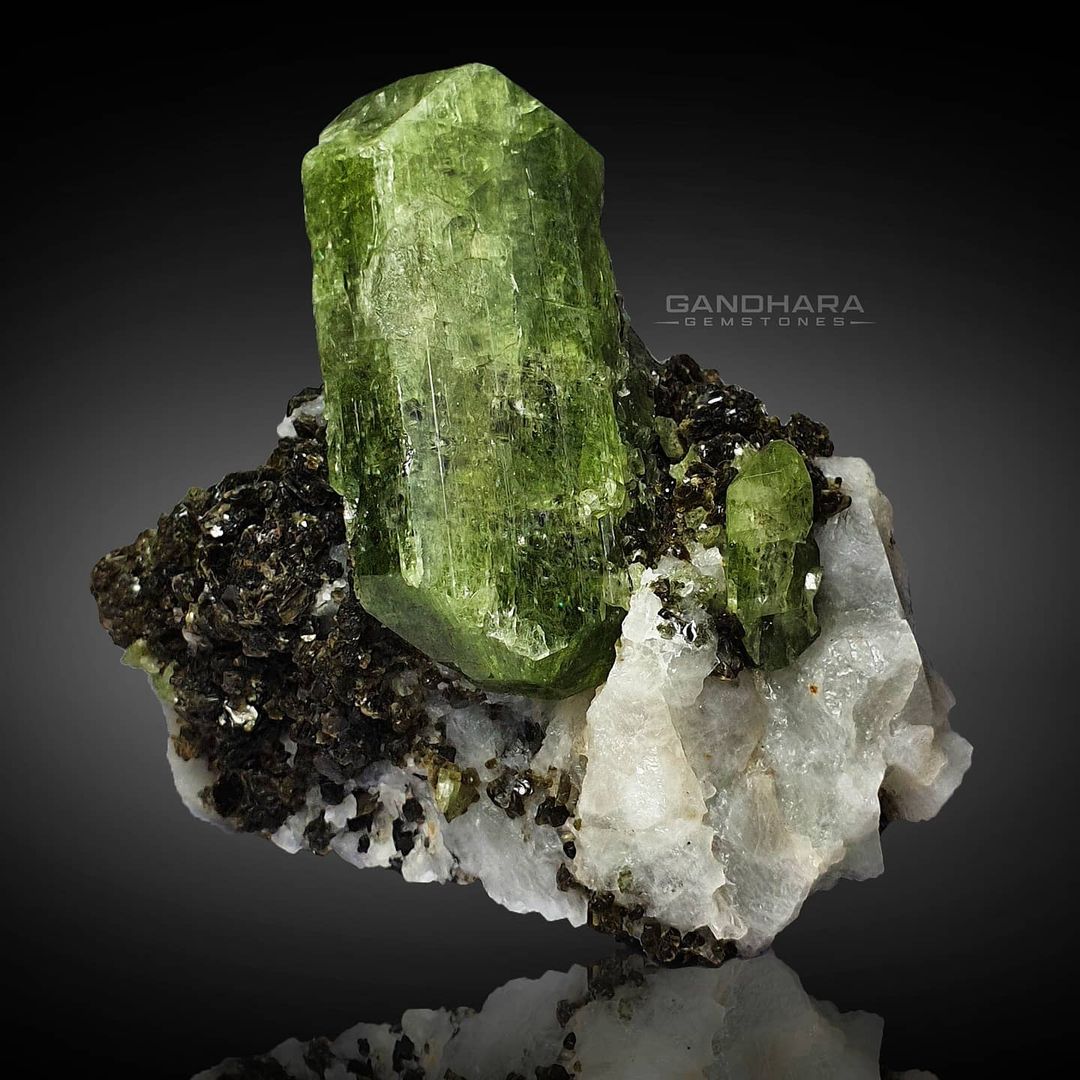
Diopside Minerals

Diopside minerals are best selected by comparing natural crystal development, green or lighter body color, vitreous luster, transparency, cleavage, matrix relationships, dimensions and visible preservation rather than by choosing the darkest or largest specimen automatically. Diopside is a calcium-magnesium silicate with the formula CaMgSi₂O₆ and belongs to the clinopyroxene subgroup of the pyroxene mineral group. It crystallizes in the monoclinic system and can occur in light to dark green, colorless, white, gray, brown, blue and pale violet forms, with trace elements contributing to many of these color variations.

Diopside Crystal For Sale, Price,

Natural diopside minerals can appear as distinct prismatic crystals, intergrown groups, crystalline masses or matrix specimens associated with other calc-silicate minerals. The mineral has Mohs hardness around 5.5 to 6.5, vitreous luster and distinct cleavage, which means a crystal can preserve bright reflective faces while still being vulnerable to breakage along structural directions. Buyers comparing diopside with other mineral specimens and crystals should therefore give crystal completeness and condition as much attention as color.

Diopside Crystal Form: Prismatic Clinopyroxene Growth

Diopside commonly forms prismatic monoclinic crystals whose cross-sections can appear nearly square or rectangular at first glance. Individual specimens may be short and blocky or relatively elongated, while intergrown crystals can create more complex groups in which several prisms meet at different angles.

A strong collector specimen usually preserves enough natural faces for the crystal habit to remain easy to understand. Sharp edges, recognizable terminations and intact side faces can make a relatively small diopside much more instructive than a large broken mass where the original form has largely disappeared.

Natural contact areas should be separated from later damage. A crystal that developed against calcite or another neighboring mineral may never have formed a complete face in that direction, while a fresh chip removes part of an existing edge or termination. Multiple viewing angles help buyers make that distinction more confidently.

Diopside Color: Light Green to Deep Green and Less Common Variations

Green is the color most strongly associated with diopside, but natural diopside minerals display considerable variation. Iron commonly contributes to green coloration, while chromium can produce the vivid saturated greens associated with chrome diopside. Other compositions can appear colorless, white, gray, pale violet, blue or brown.

Color should not be treated as a simple quality scale. A deep green crystal may appear nearly opaque in thick sections, while a lighter green specimen can reveal far more transparency and internal structure. The strongest collector choice depends on whether the color complements the crystal form and luster rather than merely reaching maximum saturation.

Thin edges can also appear lighter than the body of the crystal. This is normal in strongly colored specimens because more light can pass through the thinner sections, revealing green tones that may be difficult to see through the center.

Chrome Diopside and Ordinary Diopside: Same Mineral Species, Different Color Chemistry

Chrome diopside is the vivid green chromium-bearing variety familiar to many gemstone buyers. It remains diopside mineralogically, with chromium contributing to the stronger green coloration rather than creating a separate mineral species.

Natural crystal specimens do not need gem-quality transparency or intense chromium color to be collectible. Pale green, gray-green or even nearly colorless diopside can be excellent mineral specimens when the crystal form, matrix and preservation are strong.

Buyers interested primarily in transparent cut stones can compare chrome diopside gemstones, while this collection remains centered on natural mineral morphology, crystal associations and geological context.

Diopside Luster and Transparency: Why Crystal Faces Matter

Diopside generally shows vitreous luster on well-preserved crystal faces. This glass-like reflection can make individual faces stand out clearly even when the body color is dark green.

Transparency ranges from transparent to opaque, and the best quality standard depends on the specimen type. A transparent green crystal may reveal internal inclusions and zoning, while an opaque crystal can still be highly collectible when its faces and termination remain sharp.

Surface preservation deserves careful attention because abrasion can reduce luster and soften crystal edges. Natural growth textures and minor contact areas should not be mistaken for polishing defects, however. A specimen is expected to preserve its geological history rather than display artificially perfect surfaces.

Diopside Cleavage: Why Hardness Does Not Prevent Breakage

Diopside has distinct cleavage typical of pyroxene minerals. This means the crystal can separate more readily along particular structural planes even though its Mohs hardness provides reasonable resistance to scratching.

Hardness and toughness should therefore not be confused. A diopside crystal may resist a light scratch while still chipping if dropped or struck against a harder object, particularly where cleavage intersects a corner or termination.

This becomes especially important with projecting crystals on matrix. The specimen should be handled from a stable base rather than by an exposed prism, because leverage can place considerable force on an attachment point that appears stronger than it actually is.

Diopside in Skarns and Calc-Silicate Rocks

Diopside commonly forms in metamorphic environments where carbonate-rich rocks interact with silica-rich fluids or undergo high-temperature reactions. Skarns and related calc-silicate rocks can contain diopside alongside garnet, vesuvianite, calcite, wollastonite and other minerals.

These associations can make matrix specimens especially informative. Green diopside against white calcite can provide strong visual contrast, while specimens containing garnet or vesuvianite may preserve several stages of the same metamorphic mineral assemblage.

A matrix specimen should still be evaluated structurally. Dense crystals attached to fractured calcite or altered host rock can become unstable even when the diopside itself remains intact.

Diopside vs Augite and Other Pyroxenes

Diopside belongs to the clinopyroxene subgroup and shares structural relationships with several visually similar pyroxenes. Augite, hedenbergite and intermediate compositions can overlap substantially in color and external habit.

This means a green or dark prismatic pyroxene cannot always be identified as diopside from appearance alone. Chemistry becomes particularly important in compositions that lie between ideal end members, where visual differences may be subtle or absent.

For ordinary collecting, reliable provenance and established identification are useful. Advanced systematic collectors may require chemical analysis when exact pyroxene composition is central to the specimen's significance.

Diopside Twinning and Intergrown Crystals

Simple and multiple twinning can occur in diopside, creating crystals that appear joined or repeated according to specific structural relationships. Intergrown specimens may therefore look more complex than an isolated monoclinic prism.

Twinning can add collector interest when the relationship remains easy to see. A complete twin may demonstrate crystal structure more effectively than a larger single crystal with extensive damage.

The junction between twinned individuals should be examined carefully because broken or repaired specimens can sometimes resemble natural intergrowths in photographs. The complete specimen should show consistent surfaces and natural continuity through the twin relationship.

Diopside Hardness and Care for Mineral Specimens

With Mohs hardness around 5.5 to 6.5, diopside has moderate scratch resistance but remains softer than quartz, beryl, topaz and corundum. Contact with these harder minerals can mark natural faces, particularly during storage or transport.

The mineral is also brittle, and distinct cleavage increases sensitivity to impact. Separate storage and stable cabinet positioning therefore matter more than frequent polishing or cleaning.

The practical recommendations under gemstone care provide a useful foundation. Natural crystal specimens should be dusted gently and handled conservatively rather than subjected to aggressive cleaning that might affect the diopside or its associated matrix.

Diopside Mineral Identification: Why Green Color Is Not Enough

Green crystal specimens can belong to many mineral species. Epidote, amphiboles, vesuvianite, garnet and tourmaline can overlap visually with diopside depending on crystal habit, color and matrix.

Diopside identification becomes stronger when monoclinic pyroxene form, cleavage, hardness, luster, specific gravity and geological association are considered together. Exact chemistry may still be required when closely related clinopyroxenes are involved.

Gandhara Gems' authenticity guarantee provides useful purchasing context when mineral identity matters. Collectors should also preserve locality information because geological setting can contribute important supporting evidence.

Diopside Mineral Specimens vs Faceted Diopside

Transparent green diopside can be faceted into attractive gemstones, particularly chromium-bearing material. Natural crystals, however, preserve information that cutting removes permanently, including growth faces, terminations, matrix contacts and geological associations.

A complete transparent diopside crystal should therefore not automatically be regarded as cutting rough. If the natural morphology is strong, preserving the specimen may retain greater mineralogical interest than faceting it.

Broken transparent fragments offer a different decision. When little original crystal form remains, gem cutting may become a more practical use if the interior is sufficiently clean and structurally sound.

Diopside Dimensions and Display Scale

Macro photography can make a small green crystal appear considerably larger than it is, especially when the frame is filled with reflective faces. Actual length, width and height should therefore be checked before purchase.

Matrix contributes to total size and weight without necessarily increasing the dimensions of the focal crystal. A substantial specimen may contain only one modest diopside prism, while a lightweight cluster can display several crystals prominently.

Display planning should also account for projecting terminations. A crystal that extends above the matrix needs enough clearance from shelves and neighboring minerals to avoid accidental contact.

Buying Diopside Minerals Online: Compare Form, Color and Condition Together

A careful online comparison begins with crystal morphology and preservation, then considers green color, transparency, luster, matrix, dimensions and any visible cleavage-related fractures. Several viewing angles make it easier to identify contact faces and fresh damage.

Collectors should decide whether they want a classic prismatic crystal, a green matrix association, a transparent specimen or a more complex intergrown group. These styles satisfy different collecting goals and should not be forced into one universal ranking.

Choose the current Diopside Mineral whose crystal geometry, natural color and structural condition best fit the type of specimen you want to add to your collection.

Diopside Mineral FAQs

What is diopside made of?

Diopside is a calcium-magnesium silicate with the formula CaMgSi₂O₆. It belongs to the clinopyroxene subgroup within the pyroxene mineral group. Natural compositions can contain trace or minor amounts of iron, chromium, manganese and other elements, helping produce the range of colors seen in collector specimens.

Is chrome diopside a different mineral from ordinary diopside?

No. Chrome diopside is chromium-bearing diopside with vivid green coloration. It remains the same mineral species, although its trace-element chemistry produces a distinctive gem-quality appearance. Mineral specimens can be collectible without chromium-rich color when their crystal form, matrix or provenance is strong.

How hard are diopside crystals?

Diopside has Mohs hardness approximately 5.5 to 6.5. This provides moderate scratch resistance, but the mineral is brittle and has distinct cleavage. A crystal can therefore chip or break from impact even though its natural faces seem relatively hard.

Why do some diopside crystals look almost black?

Deeply colored or thick green diopside can absorb enough light to appear nearly black under ordinary illumination. Strong transmitted light may reveal green along thinner edges or internal zones. Thickness, composition and lighting all influence the apparent color.

What minerals commonly occur with diopside?

Diopside can occur with calcite, garnet, vesuvianite, wollastonite and other calc-silicate minerals in metamorphic and skarn environments. Pegmatitic and other geological settings can produce different associations. Matrix relationships can add substantial scientific interest when they are well preserved.

Is a transparent diopside crystal better than an opaque one?

Not automatically. Transparency can be attractive, but mineral specimen quality also depends on natural crystal form, termination, luster, matrix and condition. An opaque crystal with exceptional morphology can be more collectible than a transparent fragment whose original crystal structure has been heavily damaged.

Choose Diopside Minerals by Crystal Form, Green Color and Preservation

Compare the current Diopside Minerals by monoclinic prismatic growth, light to dark green color, vitreous luster, transparency, cleavage, matrix association and actual dimensions. Give particular attention to intact terminations and stable attachment because those features preserve the mineral's natural pyroxene character most clearly. Choose the individual diopside whose form, condition and geological context best fit your collection and display.

Gemstone expert consultations available

Welcome to my shop! Contact Us

Recently Viewed Products
