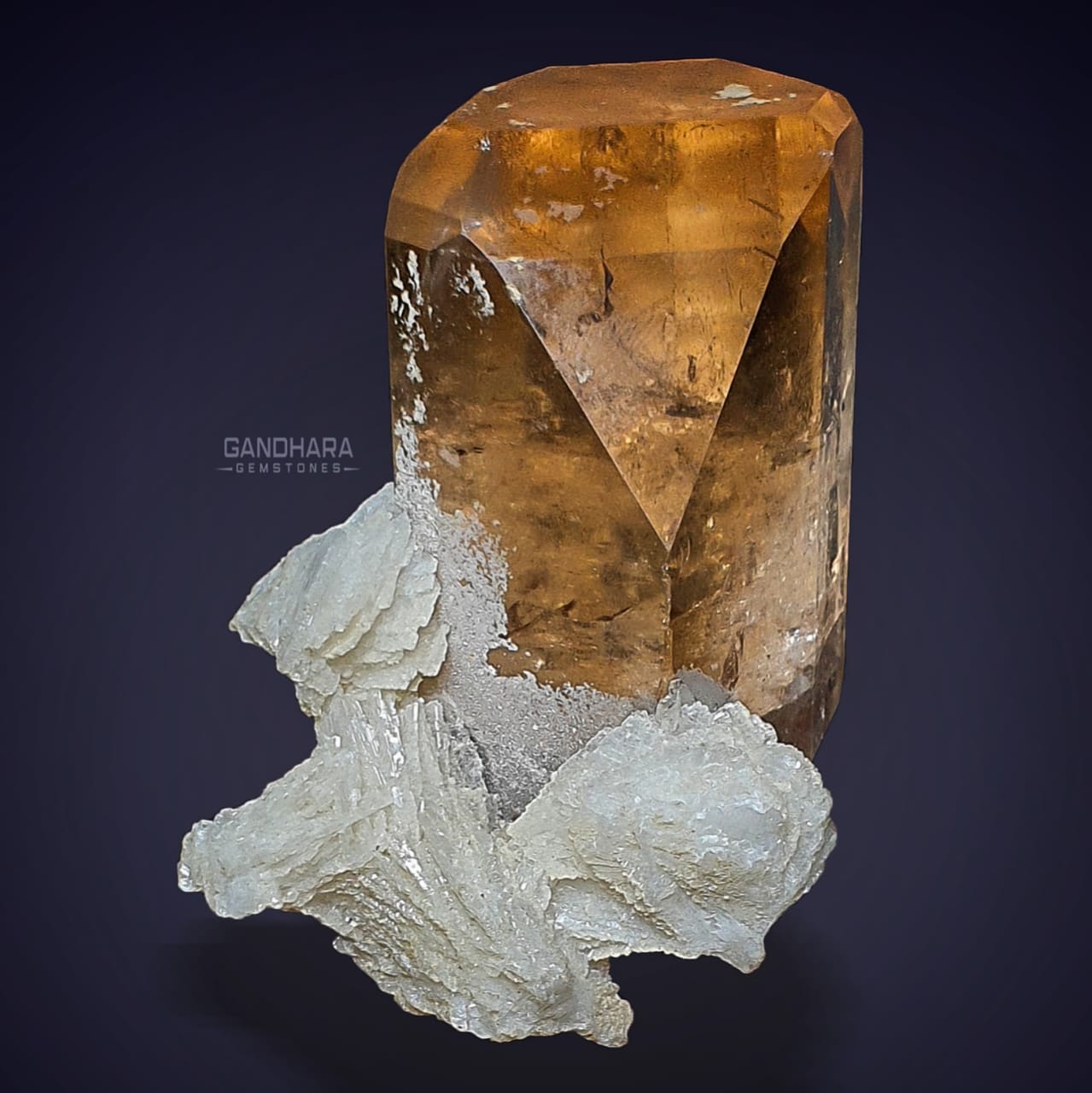
Topaz Stone

A natural topaz crystal should be chosen by considering preserved crystal form, color, transparency, termination, inclusions, matrix, physical dimensions and visible condition rather than treating size or carat weight as the main indication of quality. Topaz is an orthorhombic mineral that can form substantial transparent crystals, and natural specimens can display elongated or columnar shapes with clearly defined faces that provide a very different collecting experience from polished jewelry stones. A crystal that retains strong morphology may have considerable specimen appeal even when internal features would make it less suitable for faceting.

Topaz Stone

The distinction between a mineral specimen and cutting material is particularly important with topaz because some crystals can be both visually attractive in their natural state and capable of yielding polished gemstones. Buyers interested primarily in finished color, brilliance and known face-up measurements can compare topaz gemstones, while lapidaries who intend to shape their own stones may prefer rough topaz gemstones. A preserved specimen should instead be evaluated for characteristics that would disappear permanently once the crystal is sawn, preformed and faceted.

Natural Topaz Crystal Form: Why Prismatic Growth and Termination Quality Matter

Topaz commonly develops prismatic crystals whose length and cross-sectional shape can make them visually striking even without cutting. Well-defined natural faces allow a collector to appreciate the mineral's orthorhombic growth, while an intact termination can provide a clear endpoint to the crystal and strengthen the overall sense of completeness. Large size can be impressive, but a smaller crystal with sharper form and fewer damaged edges may show the mineral's natural architecture more effectively.

Surface features should be interpreted carefully because not every irregularity represents damage. Contact areas can form where neighboring minerals or host rock prevented a face from developing freely, while natural growth textures may create uneven or patterned surfaces. Recent chips tend to interrupt an established crystal edge or expose a fresh broken surface, and their importance depends strongly on whether they affect the principal display face or termination.

Collectors should therefore look at the whole crystal rather than searching for manufactured perfection. Natural morphology, preservation and the way the piece presents from its strongest viewing direction are more meaningful than expecting every face to be equally smooth or complete.

Topaz Crystal Color: Comparing Colorless, Blue, Yellow, Pink and Warm-Toned Specimens

Topaz has a remarkably wide color range that can include colorless, yellow, orange, brown, pink, red, pale green and blue. Natural colorless crystals are relatively abundant, while strong commercial blue topaz is commonly produced through treatment. For mineral specimen buyers, this distinction matters because an attractive crystal shape does not by itself establish whether its present color represents an untreated natural state.

Crystal thickness can also change the apparent intensity of color. A pale yellow or blue crystal may show stronger saturation through its thickest section and nearly colorless edges, while transparent specimens can shift visually according to lighting and background. The most saturated crystal is therefore not necessarily the strongest specimen if another piece offers better termination, morphology or preservation.

Collectors interested in topaz as a mineral should give appropriate weight to natural form and documented information instead of assuming that the strongest blue, yellow or pink appearance is automatically preferable. When treatment history is important, visual color alone is not sufficient evidence.

Topaz Transparency and Inclusions: Evaluating Natural Internal Character

Topaz can form with excellent transparency, and this characteristic can make natural crystals especially attractive because internal features remain visible without polishing. Mineral inclusions, fractures, growth structures and other features can occur, and their significance depends on whether they contribute visual interest or create a structural weakness.

A transparent topaz crystal containing a small mineral inclusion can provide geological character that would be considered differently in a polished jewelry stone. By contrast, a deep surface-reaching fracture that intersects the main crystal can increase vulnerability, particularly because topaz has perfect basal cleavage. Buyers should therefore distinguish between an inclusion that changes appearance and a break that affects physical stability.

Clarity should not become the sole buying standard for a specimen. A perfectly transparent crystal with a badly damaged termination may be less compelling to a mineral collector than a slightly included crystal with exceptional form and well-preserved natural faces.

Topaz Cleavage: Why a Mohs Hardness of 8 Does Not Make Crystals Indestructible

Topaz has Mohs hardness 8, so intact surfaces resist scratching well compared with quartz and many softer minerals. Its toughness tells a different story because topaz has perfect basal cleavage and can separate when force is applied unfavorably. This difference between hardness and resistance to breakage is one of the most important ownership considerations for both mineral specimens and polished topaz.

Natural crystals should therefore be handled by a secure base rather than by exposed terminations or projecting areas. A large topaz specimen can have substantial mass, and even a relatively short fall can place enough force on a cleavage-sensitive section to produce irreversible damage. Existing fractures can increase that vulnerability further.

The same care is important during cleaning. Sudden temperature changes and aggressive mechanical methods are unnecessary risks, particularly when a crystal contains fractures or remains attached to matrix. Gandhara Gems' gemstone care information provides useful ownership guidance, but the individual structure of a natural topaz specimen should always determine how cautiously it is handled.

Topaz Matrix Specimens: How Host Rock Changes Collector Appeal

A topaz crystal preserved on matrix can show considerably more geological context than an isolated crystal. The surrounding rock or associated minerals may reveal how the topaz grew and can create contrast that makes transparent or pale-colored crystals easier to see. A well-positioned topaz on matrix can therefore have collector appeal even when the primary crystal is smaller than an isolated specimen.

Composition matters more than the amount of matrix. A large host rock with a partially hidden crystal may be less visually effective than a compact specimen where the topaz forms a clear focal point. Associated minerals can add further interest when they are naturally arranged and do not obscure the principal crystal.

Matrix also affects handling because the complete piece is only as stable as its weakest component. A hard topaz crystal attached to fractured or crumbly host rock can detach if the specimen is lifted incorrectly, making the base and attachment points worth examining before purchase.

The range of mineral specimens and crystals makes these differences easier to appreciate because topaz's prismatic form and cleavage behavior contrast with the structures of quartz, garnet, fluorite and other collector minerals.

Natural Topaz Color and Treatment: What Collectors Should Understand

Color treatment is particularly important in topaz because much of the bright blue material encountered in the gem trade begins as colorless or lightly colored natural topaz and receives irradiation followed by heat to create the familiar blue appearance. Surface coatings can also be used to create unusual colors, which means an attractive exterior effect should not automatically be interpreted as natural crystal coloration.

These practices do not change the fact that the underlying mineral may be natural topaz. They do, however, demonstrate why natural origin and untreated color are separate characteristics. A collector specifically seeking naturally colored mineral specimens should pay attention to available disclosure rather than relying on a crystal's unpolished appearance.

Gandhara Gems' authenticity guarantee provides relevant context concerning gemstone and mineral identity. When precise treatment determination is important for a high-value or scientifically organized collection, appropriate gemological testing provides stronger evidence than photography alone.

Topaz Crystal Size and Weight: Why Large Specimens Still Need Quality Comparison

Topaz can form exceptionally large crystals, so impressive size is a genuine characteristic of the mineral rather than something unusual in every case. That ability to grow large also means size alone should not be treated as proof of exceptional specimen quality. A substantial crystal may contain broken terminations, internal fractures or surfaces that make it less attractive than a smaller but more complete piece.

Dimensions are generally more useful than weight for understanding how a specimen will function in a collection. Length, width and height indicate whether the crystal fits a cabinet, stand or display arrangement, while weight cannot reveal whether the mass is concentrated in a compact form or spread through substantial matrix.

Collectors should also consider whether the crystal has a stable natural resting position. Tall prismatic pieces may require additional support, particularly when their strongest viewing orientation places the center of gravity away from the base. A specimen that can be displayed securely without stress on the crystal or matrix is easier to preserve over the long term.

Topaz Mineral Specimens and the Jewelry Tradition

Topaz has a long jewelry history and is traditionally associated with November, but that cultural role should remain separate from the mineralogical criteria used to choose a natural crystal specimen. The November topaz birthstone tradition centers primarily on topaz as a gemstone, whereas a specimen collector is usually more concerned with crystal growth, natural surfaces, inclusions, matrix and provenance.

The distinction can make natural topaz especially interesting to someone who already owns faceted stones. A polished gem emphasizes color, brilliance and cutting skill, while a crystal specimen preserves the physical form from which such gemstones originate. Displaying the two together can provide a useful comparison without treating the natural crystal merely as unfinished jewelry.

For buyers purchasing topaz as a personal birthstone object, the same specimen standards still matter. An intact crystal with appealing form may offer more enduring visual interest than simply choosing the heaviest piece available.

Buying a Topaz Crystal Online: Examine the Whole Specimen Before Choosing

Online photographs should be used to evaluate crystal form from several directions, especially the termination, major edges, cleavage-related breaks and areas where the topaz joins matrix. Transparency and color should be considered under realistic expectations because pale specimens can look more saturated against particular backgrounds or under concentrated lighting. Actual dimensions are essential for understanding scale, particularly when close-up photography makes a modest crystal appear much larger than it is.

Buyers should decide whether the main priority is a clean isolated crystal, an interesting matrix composition or a specimen showing unusual internal features. Those objectives can lead to different choices even when the crystals are similar in weight. A collector who values morphology may prioritize a complete termination, while another may prefer an included transparent crystal that reveals internal mineral relationships.

Unique specimens also make delivery and post-arrival inspection important parts of the buying process. Gandhara Gems' shipping information explains the applicable order process, and the return policy provides the relevant conditions for evaluating a crystal after it reaches the buyer.

Topaz Crystal FAQs

What should I look for when choosing a natural topaz crystal?

A useful comparison starts with crystal form, termination condition, natural color, transparency, visible fractures, matrix and actual physical dimensions. Collectors who prioritize morphology may prefer a smaller crystal with sharp, intact faces over a larger piece with significant breakage, while buyers interested in inclusions may accept more internal features if they contribute geological character. The strongest choice is therefore the specimen whose combination of natural structure and preservation fits the purpose of the collection rather than simply the heaviest topaz available.

Is topaz durable because it has Mohs hardness 8?

Mohs hardness 8 means topaz resists scratching relatively well, but it does not describe the mineral's resistance to separating. Topaz has perfect basal cleavage, so a strong impact or unfavorable pressure can cause a crystal to break even when its surfaces remain difficult to scratch. Natural specimens should therefore be handled carefully, particularly around terminations, fractures and narrow matrix attachments.

Is blue topaz naturally blue?

Natural blue topaz exists, but much of the bright blue topaz in the commercial gem market receives irradiation and heat treatment to develop its color. An uncut crystal appearance does not by itself establish that blue coloration is untreated, so collectors who consider treatment history important should rely on specific disclosure or testing rather than visual assumption. Natural geological origin and natural untreated color are separate questions.

Are inclusions undesirable in a topaz mineral specimen?

Not necessarily, because mineral collectors often value natural internal features that reveal something about crystal formation. Small mineral inclusions or growth structures can make a transparent topaz more distinctive, while significant fractures deserve more caution when they affect stability or intersect the crystal's cleavage-sensitive structure. The important distinction is whether an internal feature adds character or materially weakens the specimen.

Should I buy the largest topaz crystal I can afford?

Large topaz crystals can make impressive displays, but size should be compared with termination quality, surface preservation, clarity, color and structural condition. A smaller crystal with strong natural morphology can have greater collector appeal than a much larger example whose important faces are broken or whose best display angle is unstable. Physical dimensions and overall composition usually provide a more useful buying framework than weight alone.

Choose a Topaz Crystal by Natural Form, Color and Structural Integrity

Compare the topaz crystals currently available by prismatic form, termination, natural color, transparency, inclusions, cleavage-related condition, matrix and practical display dimensions. An isolated crystal may be ideal when clearly readable morphology is the priority, while a matrix specimen can preserve geological relationships that add depth to a mineral collection. Rather than allowing color intensity or total size to dominate the decision, choose the individual topaz crystal whose preserved natural features, structural condition and overall presentation best fit your collecting purpose and budget.

Gemstone expert consultations available

Welcome to my shop! Contact Us

Recently Viewed Products
