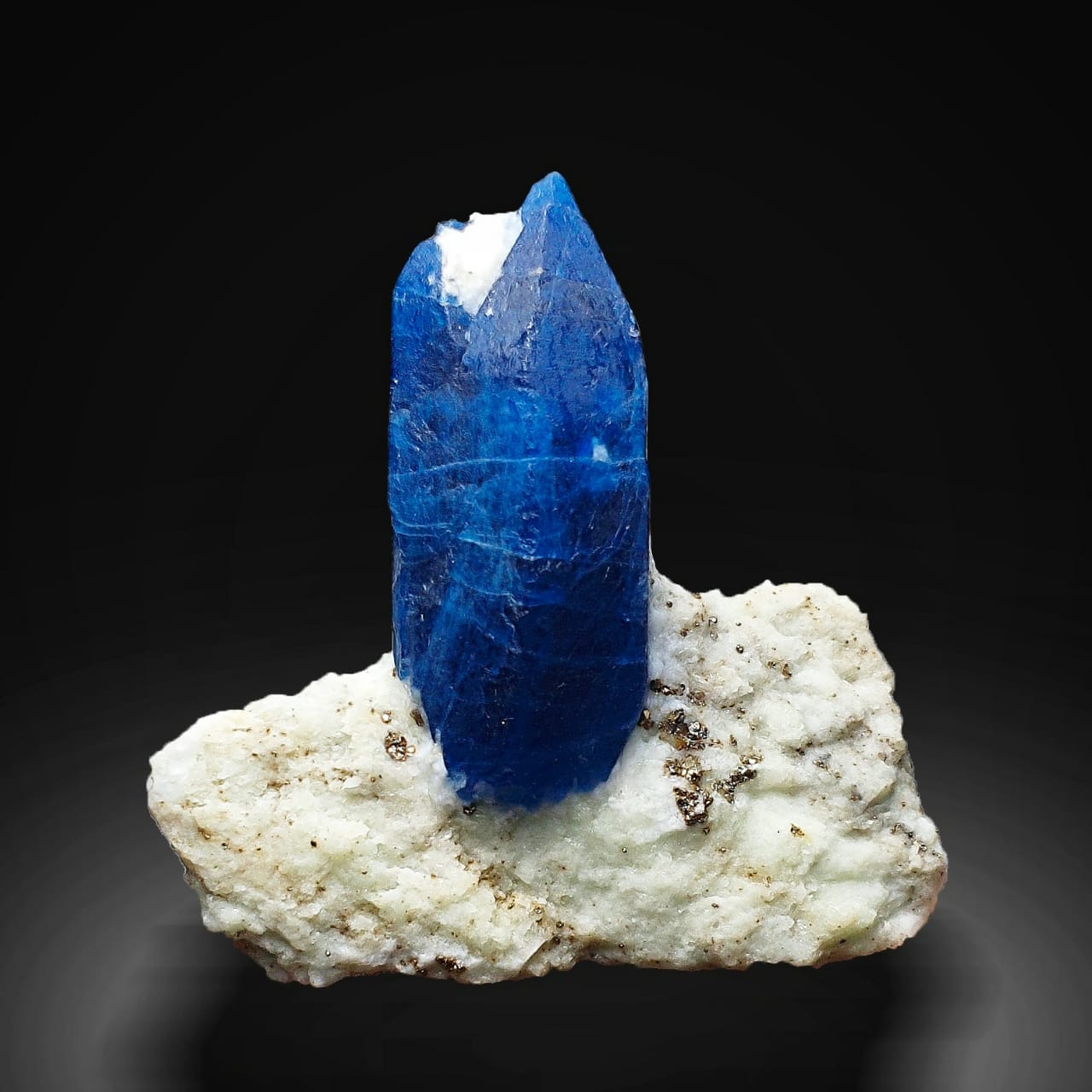
Afghanite Minerals

Afghanite minerals are best selected by comparing natural blue color, crystal development, vitreous luster, transparency, matrix associations, physical dimensions and visible preservation rather than by choosing the deepest blue specimen automatically. Afghanite is a distinct sodium-calcium aluminosilicate mineral containing sulfate and chloride, belongs to the cancrinite group and crystallizes in the trigonal system. Natural material can appear white, light blue or considerably deeper blue, giving collectors a range of appearances from pale crystalline specimens to richly colored pieces that can resemble other minerals associated with lapis lazuli deposits.

Buy Afghanite Minerals at best price

The mineral was named after Afghanistan, where its type locality occurs at Sar-e-Sang in Badakhshan. That historical connection is especially significant because Afghanite was described from a lapis lazuli-bearing geological environment and can occur with calcite, lazurite, pyrite, sodalite and other associated minerals. For collectors, those relationships make matrix and provenance particularly interesting. A specimen that preserves Afghanite alongside recognizable associated minerals can communicate far more geological context than a loose blue fragment whose identity depends entirely on color.

Afghanite Blue Color: From Pale Sky Blue to Deep Saturated Crystals

Blue is the appearance most strongly associated with Afghanite, although natural crystals can range from very pale or almost white through light blue to considerably deeper blue. Crystal thickness and transparency influence how saturated the color appears, so thin edges may look brighter or lighter than thicker sections of the same specimen.

The deepest blue is not automatically the strongest collector choice. A lighter Afghanite crystal with well-developed faces, good vitreous luster and a clear relationship with matrix may offer greater mineralogical interest than a darker piece whose natural form has been heavily damaged or obscured.

Lighting also matters because a transparent or translucent crystal can change character when viewed under reflected versus transmitted light. Buyers should therefore consider several photographs and actual dimensions rather than relying on one strongly illuminated image to represent how the specimen will look in an ordinary cabinet.

Afghanite Crystal Structure: Why Natural Form Helps Separate It From Similar Blue Minerals

Afghanite crystallizes in the trigonal system and belongs to the cancrinite group, which gives it a different mineral structure from several visually similar blue species. Well-formed crystals can show geometric faces and vitreous surfaces that distinguish the specimen from massive blue material where crystal morphology is not visible.

The preserved crystal form becomes particularly important because Afghanite can occur in geological associations containing lazurite and sodalite, both of which may also be blue. When crystals are small, broken or embedded in matrix, visual identification can become more challenging, making morphology and reliable specimen information more useful than color alone.

Natural contact areas should not automatically be classified as damage. Afghanite can grow against calcite and other associated minerals, preventing certain faces from developing freely. Fresh chips are more relevant when they interrupt previously formed crystal edges or remove an important portion of the focal specimen.

Afghanite and Lazurite: Similar Blue Color but Different Mineral Species

Afghanite can occur alongside lazurite in the same geological environment, particularly at its type locality in the lapis lazuli-bearing deposits of Sar-e-Sang. Their shared blue color can cause confusion when crystals are small or partly embedded in matrix, but they are distinct mineral species with different chemistry and crystal characteristics.

Lazurite is the principal blue mineral responsible for much of the classic color in lapis lazuli, whereas Afghanite belongs to the cancrinite group and represents its own mineralogical species. Collectors comparing blue specimens can place Afghanite alongside lazurite minerals to appreciate how different natural forms and associations can occur within broadly similar blue palettes.

The distinction should remain evidence-based. A deep blue grain within white calcite should not automatically be identified as Afghanite or lazurite solely from its color. Reliable locality information, morphology and mineralogical testing provide stronger identification support when exact species matters.

Afghanite Matrix Specimens: Calcite, Lazurite and Associated Minerals Add Context

Afghanite's association with lapis-bearing geological environments makes matrix specimens especially interesting. Blue crystals may occur against pale calcite, while pyrite, lazurite, sodalite or other minerals can appear elsewhere on the same specimen. These contrasts can create visually attractive pieces while preserving evidence of the mineral assemblage in which Afghanite formed.

A strong matrix specimen does not need the largest crystal if the Afghanite remains clearly visible and well positioned. Several small blue crystals on white calcite can produce a particularly effective composition because the color contrast makes the mineral easy to appreciate, while an isolated larger crystal may appeal more to a systematic collector focused on morphology.

The host should also be assessed structurally. Calcite is softer than Afghanite and can cleave readily, so an Afghanite crystal attached to calcite should be handled according to the vulnerability of the complete specimen rather than according to Afghanite's properties alone.

Afghanite Hardness and Durability: Suitable for Collecting but Not Rough Handling

Afghanite has Mohs hardness around 5.5 to 6, providing moderate resistance to scratching while leaving it softer than quartz, beryl, topaz and corundum. Natural specimens should therefore be stored so that harder minerals cannot rub directly against exposed Afghanite surfaces.

The mineral's hardness number also does not describe every vulnerability in a matrix specimen. A blue crystal may be structurally sound while the surrounding calcite or another host mineral is much more fragile, making careless gripping or impact a risk to the entire composition.

The practical principles under gemstone care are useful for preserving collector pieces, but complex mineral specimens should always be approached conservatively. Gentle dust removal, protected storage and minimal unnecessary handling are generally better choices than aggressive cleaning methods that could damage associated minerals.

Afghanite Transparency and Luster: Why Clearer Is Not Automatically Better

Afghanite can range from translucent to more transparent in well-crystallized material, and its vitreous luster can make natural faces visually attractive even when the crystal is small. Transparent edges may reveal lighter blue color, while thicker zones can appear much more saturated.

Transparency can add appeal because it allows light to move through the crystal, but it should not become the sole quality standard. A translucent deep-blue Afghanite on contrasting calcite can make an excellent mineral specimen even if it would not satisfy the clarity expectations applied to a faceted gemstone.

Surface condition and natural crystal form often matter more to mineral collectors. A clear fragment with no recognizable morphology may provide less specimen interest than a somewhat included crystal whose natural faces, termination and geological associations remain intact.

Afghanite Type Locality and Provenance: Why Sar-e-Sang Matters

Afghanite was named after Afghanistan and was first described from the Sar-e-Sang area in Badakhshan, one of the world's historically important lapis lazuli regions. At the type locality, Afghanite occurs in a lapis lazuli-bearing skarn and has been documented with minerals including calcite, lazurite, pyrite, sodalite, nepheline, phlogopite and others.

This connection gives locality information particular importance for collectors. A documented Sar-e-Sang Afghanite is not simply blue because of a familiar regional label; it is tied to the locality where the species was first scientifically described.

That does not mean every Afghanite specimen should automatically be assigned to Sar-e-Sang. The mineral has been reported from other occurrences, and provenance should be supported rather than inferred from blue color or associated calcite. Buyers should preserve reliable locality labels when supplied because that information can become an important part of the specimen's scientific and historical context.

Afghanite Authenticity: Why Appearance Alone Cannot Confirm the Species

Afghanite can resemble lazurite, sodalite and other blue minerals visually, making reliable identification particularly important for specimens that lack obvious crystal morphology. Color is useful as an initial observation but cannot establish chemistry or crystal structure on its own.

For a collector building a precise mineral suite, reliable labeling or analytical identification is far more valuable than an unsupported assumption based on appearance. Specimens from well-documented localities can provide additional confidence, but locality alone should still not replace correct mineral identification.

Gandhara Gems' authenticity guarantee provides relevant purchase context when mineral identity matters, while advanced collectors may choose to obtain laboratory confirmation for particularly significant specimens where exact species assignment is central to the purchase.

Afghanite Dimensions and Display: Small Crystals Can Carry Strong Mineralogical Interest

Afghanite specimens do not need to be large to be meaningful. A small well-formed blue crystal associated with contrasting calcite or lazurite can provide considerable visual and mineralogical interest, especially when the crystal faces remain sharp and clearly visible.

Close-up photography can make such crystals appear much larger than they are, which makes actual length, width and height essential when shopping online. A specimen intended for a thumbnail box will create a different display experience from a cabinet-sized matrix piece even if both photographs show similar detail.

Buyers should also think about the strongest display orientation. Matrix specimens may need support so the Afghanite remains visible without resting on delicate calcite edges, while isolated crystals should be stored securely enough that they cannot move against harder neighboring specimens.

Buying Afghanite Minerals Online: Compare Color, Association and Provenance Together

A useful online comparison begins with whether the Afghanite is clearly visible and whether its blue color, luster and crystal form can be evaluated from more than one direction. Matrix should then be considered for both visual contribution and structural stability, particularly when soft calcite forms a large part of the specimen.

Locality information deserves close attention because documented provenance can add significant interest to a species named after Afghanistan and first described from Sar-e-Sang. Buyers should distinguish a verified locality from a visual assumption and preserve any supplied labels after purchase.

Gandhara Gems' shipping information provides the practical delivery framework, while the return policy explains the applicable conditions for assessing color, dimensions and condition once the specimen can be viewed directly.

Afghanite Mineral FAQs

What is Afghanite?

Afghanite is a distinct blue-to-white mineral species in the cancrinite group and crystallizes in the trigonal system. It was named after Afghanistan, where it was first described from the Sar-e-Sang lapis lazuli deposits in Badakhshan. Its blue color can make it visually resemble lazurite or sodalite, but Afghanite has its own chemistry and mineral structure and should be identified independently rather than treated as another name for lapis lazuli.

Is every blue mineral from Afghanistan Afghanite?

No. Afghanistan, particularly the Sar-e-Sang area, produces several blue minerals and lapis-bearing assemblages that can contain lazurite, sodalite and Afghanite alongside calcite, pyrite and other species. Blue color alone therefore cannot establish that a specimen is Afghanite. Crystal morphology, reliable locality records and appropriate mineralogical identification provide much stronger evidence than geographic association or color by themselves.

Why are Afghanite specimens often associated with calcite and lazurite?

Afghanite's type occurrence is a lapis lazuli-bearing skarn where it formed in association with minerals including calcite and lazurite. Those natural relationships can be preserved in matrix specimens, which is why some collector pieces show blue Afghanite crystals against white calcite or alongside other blue minerals. Such associations can add geological interest, but each mineral should still be identified correctly rather than assumed from color.

Is darker blue Afghanite always more collectible?

Deep blue can certainly be attractive, but specimen quality depends on much more than saturation. A lighter blue crystal with sharp natural faces, strong vitreous luster and documented provenance may offer considerably more collector interest than a darker fragment with little recognizable morphology. Matrix composition, crystal completeness, condition and locality information should therefore be considered together with color.

How hard is Afghanite, and does it require special care?

Afghanite has Mohs hardness around 5.5 to 6, so it is suitable for mineral collecting but should be protected from harder specimens that could scratch exposed surfaces. Matrix pieces may require even more caution because associated calcite is softer and can be structurally fragile. Stable storage, handling from the strongest part of the specimen and avoidance of aggressive cleaning help preserve both the Afghanite and its geological association.

Why is Sar-e-Sang important when collecting Afghanite?

Sar-e-Sang in Badakhshan, Afghanistan, is the type locality where Afghanite was first scientifically described, giving specimens from that occurrence particular historical and mineralogical significance when the provenance is reliable. The area is also internationally known for lapis lazuli and contains complex mineral associations involving lazurite, calcite, pyrite and other species. A Sar-e-Sang origin should nevertheless be documented rather than assigned simply because a specimen is blue and resembles material from the region.

Choose Afghanite Minerals by Blue Color, Crystal Form and Provenance

Compare the current Afghanite Minerals by light to deep blue color, natural trigonal crystal development, vitreous luster, transparency, matrix association, actual dimensions, preservation and reliable locality information. A compact Afghanite crystal on contrasting calcite can be as compelling as a larger specimen when its morphology and geological context remain clear. Rather than choosing according to darkness or size alone, select the Afghanite whose natural form, associated minerals, condition and provenance best fit the mineral collection you are building.

Gemstone expert consultations available

Welcome to my shop! Contact Us

Recently Viewed Products
