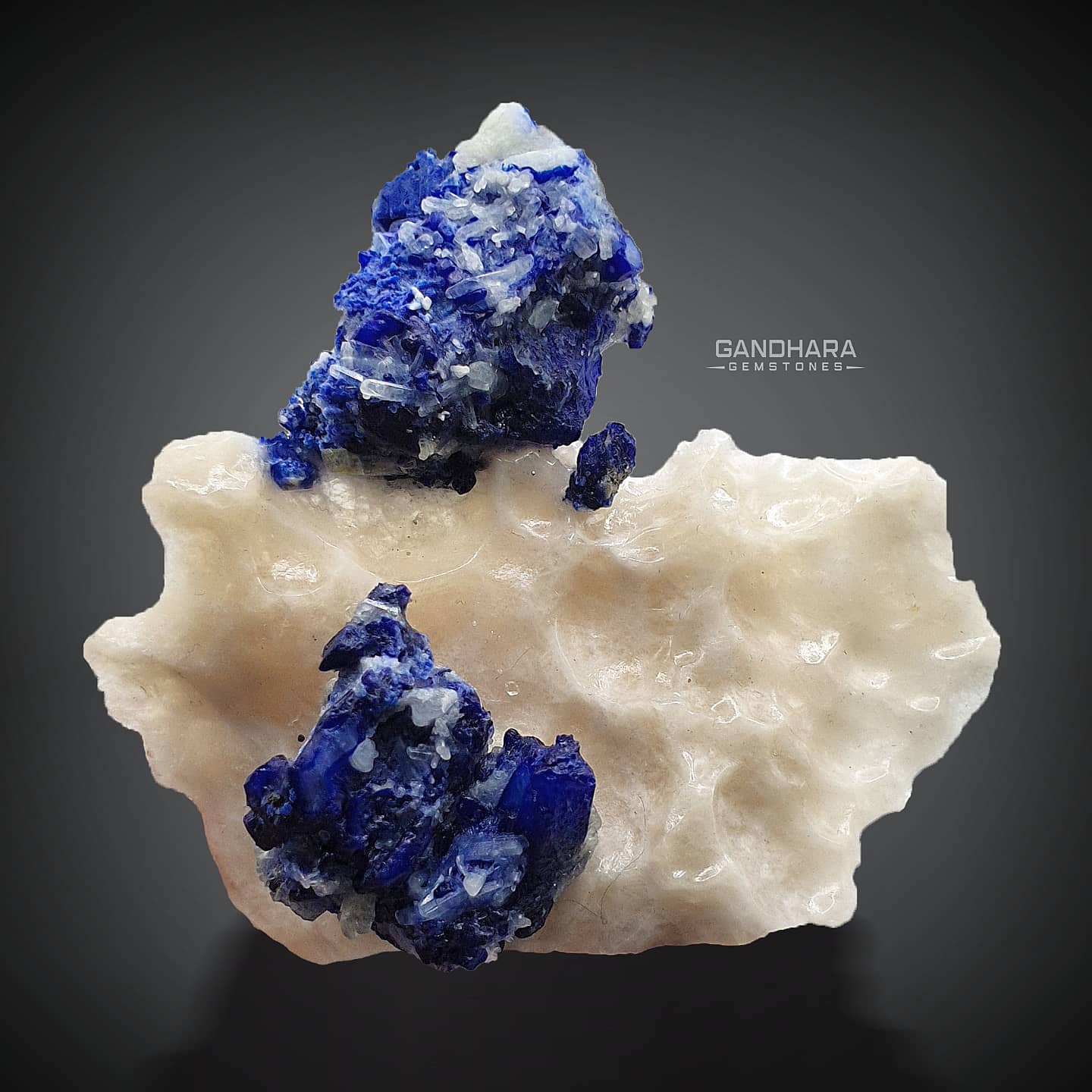
Lazurite Minerals

Lazurite minerals are best selected by comparing natural ultramarine to midnight-blue color, recognizable crystal development, surface condition, calcite or marble matrix, pyrite association, physical dimensions and reliable provenance rather than by choosing the darkest or bluest specimen automatically. Lazurite is the traditional name associated with the intensely blue sulfur-bearing sodalite-group mineral that gives much fine lapis lazuli its characteristic ultramarine color. Distinct crystals are considerably less common than massive blue material, which makes well-formed specimens particularly interesting to mineral collectors.

Buy Lazurite Minerals at the best price

Lazurite belongs to the isometric crystal system and can develop rhombic dodecahedral forms, sometimes modified by additional cube or octahedral faces. It generally has Mohs hardness around 5 to 5.5 and is brittle, with a resinous surface character rather than the glassy appearance of many transparent gemstones. Buyers comparing lazurite with other mineral specimens and crystals should therefore judge crystal form, color contrast and provenance together rather than applying standards intended for polished lapis lazuli objects.

Lazurite Blue Color: Ultramarine, Royal Blue and Midnight Tones

The defining visual characteristic of lazurite is its strong blue color. Fine specimens can range from saturated ultramarine and royal blue through darker midnight-blue shades, while some material may show subtle greenish or lighter blue influence.

The darkest specimen is not necessarily the strongest collector choice. Very dark crystals can hide individual faces when lighting is weak, while a slightly lighter blue crystal with clear dodecahedral form can display the species more effectively.

Color should also be considered in relation to matrix. Deep blue lazurite against pale marble or white calcite can create striking natural contrast, allowing even a relatively small crystal to dominate the specimen visually.

Lazurite Crystal Form: Why Sharp Dodecahedra Are Important

Well-formed lazurite commonly shows rhombic dodecahedral habit, reflecting its isometric symmetry. Additional modifications can produce more complicated forms, while other specimens may appear rounded, irregular or partially embedded in matrix.

Sharp, isolated crystals are especially interesting because lazurite is more commonly encountered as part of massive lapis-bearing rock than as an obvious free-standing crystal. A modest crystal with clearly preserved faces can therefore demonstrate the mineral's symmetry more directly than a much larger blue mass.

Termination and edge condition deserve careful inspection. Natural contacts with matrix should not be mistaken for damage, but freshly broken faces, crushed corners and repaired areas can substantially alter the appearance of a specimen whose collector appeal depends strongly on crystal morphology.

Lazurite vs Lapis Lazuli: Mineral and Rock Are Not the Same Thing

Lazurite and lapis lazuli are closely connected but should not be treated as interchangeable names. Lazurite refers to the intensely blue mineral component traditionally associated with lapis lazuli, while lapis lazuli is a metamorphic rock composed of blue sodalite-group material together with varying amounts of calcite, pyrite and other minerals.

This distinction explains why a polished piece of lapis lazuli may contain bright blue areas, white calcite and metallic pyrite without representing one single mineral crystal. A well-formed lazurite specimen, by contrast, can preserve discrete isometric crystal faces and its relationship to surrounding matrix.

Collectors interested specifically in mineral morphology should therefore judge whether the specimen shows identifiable lazurite crystals rather than evaluating it only by the visual standards used for decorative lapis lazuli.

Lazurite and Pyrite: Golden Metallic Contrast in Natural Associations

Pyrite commonly occurs with lapis-bearing rocks and can also accompany lazurite mineral specimens. Its pale brass-yellow metallic color creates strong contrast with deep blue lazurite, often producing an appearance immediately associated with lapis lazuli.

The amount of pyrite should not become the sole quality criterion. A specimen containing abundant pyrite but poorly developed lazurite may offer less mineralogical interest than a cleaner matrix piece with one sharp blue crystal.

Pyrite also needs its own condition assessment. Stable metallic grains can add visual and geological character, while heavily oxidized sulfide areas may require more careful storage. The complete association should therefore be evaluated rather than treating the blue and metallic portions independently.

Lazurite and Calcite or Marble Matrix

White to pale calcite and marble provide some of the most visually effective matrices for lazurite because they create immediate contrast with saturated blue crystals. These associations also reflect the metamorphic environments in which classic lazurite-bearing material can occur.

A matrix specimen should be judged for composition as well as stability. A blue crystal placed naturally against white marble can be highly attractive even when the overall specimen is modest in size, while a larger piece may become visually confusing if most of the crystal is hidden inside host rock.

The host can also preserve additional minerals such as phlogopite, pyrite or other silicates. These associations can strengthen geological context when they do not obscure or destabilize the focal lazurite.

Lazurite Hardness and Brittleness: Protecting Crystal Edges

Lazurite has Mohs hardness around 5 to 5.5, making it softer than quartz and many common collector minerals. Its brittle character means corners and crystal edges can chip if a specimen is dropped or stored against harder materials.

This is particularly important with sharply dodecahedral crystals because the edges carry much of the specimen's crystallographic character. Even a small chip can interrupt an otherwise clean geometric form.

Separate cabinet storage and gentle handling are preferable to repeated cleaning or polishing. The general principles under gemstone care are useful, but mineral specimens should be preserved in their natural state rather than treated like polished jewelry.

Lazurite Surface Luster: Resinous Rather Than Glassy

Lazurite commonly has a resinous luster, producing a softer reflection than highly vitreous quartz or beryl. This character can make dark blue crystals appear rich and dense rather than sharply brilliant.

Surface preservation still matters greatly. A naturally smooth face can show subtle reflection that helps define crystal geometry, while abrasion or powdery damage reduces the contrast between adjacent faces.

Collectors should not expect every lazurite crystal to sparkle strongly. The species' appeal lies more in saturated color, form and matrix contrast than in the high brilliance associated with transparent gemstones.

Lazurite Mineral Identification: Blue Color Alone Is Not Enough

Several minerals can be blue enough to resemble lazurite in photographs. Sodalite, hauyne, lazulite and azurite are among the names that can create confusion, and some of these occur in very different chemical and geological settings.

Lazulite is particularly important to distinguish because the names sound similar despite referring to different minerals. Lazulite is a magnesium-aluminum phosphate with different crystallography and physical properties, while lazurite belongs to the sodalite-group framework of sulfur-bearing aluminosilicate minerals.

Azurite is a copper carbonate mineral with different hardness, chemistry and typical crystal habit. A rich blue color therefore provides only one clue and should not replace proper identification.

Gandhara Gems' authenticity guarantee provides relevant purchasing context where mineral identity matters, especially with unusual matrix specimens or isolated blue crystals.

Lazurite Chemistry and the Origin of Ultramarine Blue

Lazurite's famous blue color is connected with sulfur species held within the cages of its aluminosilicate structure. This is one reason its color differs so dramatically from pale or colorless framework silicates that may otherwise share structural similarities.

The chemistry is more complex than a simple pigment mixed through the mineral. Sulfur-related color centers are part of the crystal structure, producing the saturated ultramarine appearance that made lazurite-bearing rock historically important as a source of blue pigment.

Collectors do not need chemical analysis to appreciate the visual effect, but the underlying chemistry helps explain why lazurite became culturally important long before modern mineral classification existed.

Lazurite Provenance: Why Locality Matters

Documented provenance can add substantial value to lazurite specimens because certain deposits are historically renowned for producing deeply colored lapis material and unusually well-developed crystals.

Afghanistan's Badakhshan region, particularly the Sar-e-Sang area, is famous for lapis lazuli and high-quality lazurite crystal specimens. Other lazurite occurrences exist, however, and a crystal should never be assigned to a famous locality from blue color or white matrix alone.

Reliable locality information should remain attached to the specimen. Provenance turns a visually attractive blue crystal into a more useful mineralogical record and prevents later assumptions from replacing documented origin.

Lazurite Crystals vs Massive Blue Material

Massive lazurite-bearing material and well-developed lazurite crystals serve different collecting interests. Massive material can show exceptional ultramarine color and interesting associations, while distinct crystals provide more direct evidence of isometric crystallography.

A collector focused on color may prefer a large saturated blue mass, whereas someone building a systematic crystal collection may choose a smaller sharp dodecahedron on matrix.

Neither approach is universally superior. The strongest specimen is the one that preserves the natural feature most relevant to the collection, whether that is crystal form, color, association or provenance.

Lazurite Meaning and Cultural History vs Mineral Science

Lazurite-bearing lapis lazuli has a long history in art, ornament and pigment production, giving the mineral substantial cultural significance beyond its physical properties. Ultramarine blue was historically prized because intense durable blue pigments were difficult to obtain.

Modern symbolic interpretations can also surround blue minerals, but those beliefs should remain separate from scientifically established properties. Lazurite's measurable characteristics involve its chemistry, structure, hardness, color and geological formation, not medical or therapeutic effects.

Keeping those subjects distinct allows the specimen's real historical and mineralogical importance to stand on its own.

Buying Lazurite Minerals Online: Compare Color, Crystal Form and Provenance

A careful online comparison begins with blue saturation and natural crystal morphology, followed by surface condition, matrix, pyrite or calcite associations, actual dimensions and locality information. Multiple views are useful because a crystal may appear sharp from the front while hiding contacts or damaged edges on the reverse.

Close-up photography can make small crystals appear substantially larger than they are, so physical measurements should be checked carefully. A sharply formed 15 mm crystal may be more significant mineralogically than a much larger blue mass even though it occupies less display space.

Choose the current Lazurite Mineral whose ultramarine color, morphology, matrix relationship and documented provenance best match the type of mineral specimen you want to add to your collection.

Lazurite Mineral FAQs

Is lazurite the same thing as lapis lazuli?

No. Lazurite refers to the intensely blue mineral traditionally associated with the color of lapis lazuli, while lapis lazuli is a rock containing blue sodalite-group material together with calcite, pyrite and other minerals. A lazurite crystal can show clear isometric form, whereas lapis lazuli is usually encountered as massive rock.

What color is natural lazurite?

Natural lazurite is best known for ultramarine, royal-blue and midnight-blue colors, sometimes with slightly greenish or lighter blue variations. The strongest collector specimen is not automatically the darkest one because crystal form, matrix contrast and condition can matter just as much as saturation.

What crystal shape does lazurite form?

Lazurite belongs to the isometric system and can form rhombic dodecahedral crystals, sometimes modified by other isometric forms. Well-defined isolated crystals are much less common than massive blue material, which is one reason sharp matrix specimens attract significant collector interest.

How hard is lazurite?

Lazurite is approximately Mohs 5 to 5.5 and is brittle. It can therefore be scratched by quartz and harder minerals, while exposed edges can chip through impact. Stable cabinet storage and gentle handling are more suitable than frequent manipulation.

Is lazurite the same as lazulite?

No. Despite the similar names, they are different minerals. Lazurite is a sulfur-bearing blue sodalite-group mineral associated with lapis lazuli, while lazulite is a magnesium-aluminum phosphate with different chemistry, structure and physical properties.

Why is pyrite often seen with lazurite?

Pyrite can occur naturally within lapis-bearing metamorphic rocks and associated lazurite specimens. Its metallic pale brass-yellow color contrasts strongly with blue lazurite and white calcite or marble. The association can add collector appeal, but pyrite abundance does not by itself determine lazurite specimen quality.

Why is provenance especially important for lazurite?

Lazurite has famous historic producing regions, and well-documented locality can connect a specimen to a specific geological and cultural source. Appearance alone cannot establish origin because blue color and pale matrix can occur in more than one locality. Preserving original labels therefore adds meaningful scientific value.

Choose Lazurite Minerals by Ultramarine Color, Crystal Form and Provenance

Compare the current Lazurite Minerals by ultramarine to midnight-blue color, isometric crystal development, surface preservation, calcite or marble matrix, pyrite association, physical dimensions and documented locality. Give particular attention to sharp dodecahedral forms and intact edges because distinct lazurite crystals are less common than massive blue material. Choose the individual specimen whose color, natural geometry and geological context best fit your mineral collection and display.

Gemstone expert consultations available

Welcome to my shop! Contact Us

Recently Viewed Products
