

-
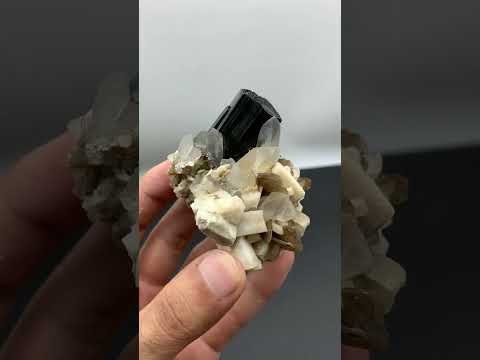
Combination Specimen of Muscovite with Schorl and Albite from Pakistan - Black
This specimen from Pakistan showcases a stunning combination of Schorl, Albite, and Muscovite. Schorl, the black tourmaline variety, stands out with its deeply jet-black, striated prismatic crystals that often have a glassy luster, adding a dramatic contrast to the piece. In contrast, Albite appears...- $450.00
- $450.00
- Unit price
- per
-
Black
-
Specimen of Black Tourmaline Crystal on Smoky Quartz from Pakistan - Black
A captivating display of nature's artistry, a stunning composition of Black Tourmaline on Albite with Smoky Quartz emerges from the depths of Pakistan's mineral-rich landscapes. The deep, enigmatic hues of Black Tourmaline seamlessly contrast with the pristine beauty of Albite, creating a visually striking...- $650.00
- $650.00
- Unit price
- per
-
Black
-
Lustrous Schorl Black Tourmaline with Quartz on Albite from Pakistan - Black
This specimen is a striking combination of lustrous Schorl Black Tourmaline crystals inter grown with clear Quartz, all set against a bed of white Albite. The jet-black Schorl exhibits sharp, well-defined prismatic formations with a glossy surface that contrasts beautifully against the translucent Quartz,...- $250.00
- $250.00
- Unit price
- per
-
Black
-
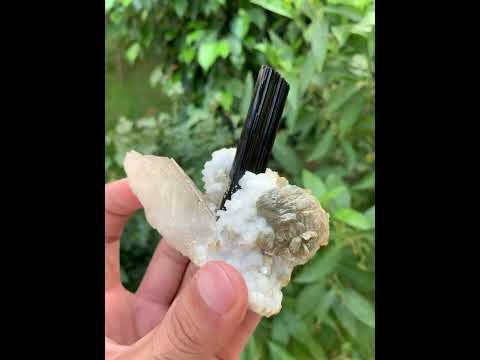
Free Standing Schorl Tourmaline on Albite with Smoky Quartz and Mica from Pakistan - Black
This stunning mineral specimen features a freestanding Schorl Black Tourmaline crystal, elegantly perched atop a bed of white Albite. The jet-black Schorl Tourmaline exhibits sharp, well-defined prismatic faces with vertical striations, creating a striking contrast against the pearly, snow-white Albite matrix. Accompanying the Schorl...- $350.00
- $350.00
- Unit price
- per
-
Black
-
combination specimen of Tourmaline on Lepidolite crystals from Pakistan - Green
Imagine a captivating geological masterpiece from the heart of Pakistan, where nature's artistry takes center stage. A mesmerizing specimen unfolds, showcasing the harmonious union of vibrant green Tourmaline cradled delicately on a canvas of soft, pink Lepidolite. The juxtaposition of these two exquisite minerals...- $1,700.00
- $1,700.00
- Unit price
- per
-
Green
-
rare combination of gem Morganite with Pollucite and Tourmaline from Afghanistan - Pink
A captivating and rare marvel, the gem Morganite takes center stage in a mesmerizing composition alongside Pollucite and Tourmaline from the enchanting landscapes of Afghanistan. The delicate pink hues of Morganite, a variety of beryl, gracefully interplay with the ethereal translucence of Pollucite, creating...- $1,650.00
- $1,650.00
- Unit price
- per
-
Pink
-
mint-green color Tourmaline crystals on Cleavelandite with Quartz from Afghanistan - Green
Picture a mesmerizing scene from the mineral kingdom where mint-green Tourmaline crystals steal the spotlight, delicately nestled on a bed of Cleavelandite adorned with Quartz, all originating from the breathtaking mines of Afghanistan. The Tourmaline crystals, with their soothing and refreshing aquamarine hue, create...- $280.00
- $280.00
- Unit price
- per
-
Green
-
Oceanic Aquamarine on Schorl Black Tourmaline with Albite from Pakistan - Black
This is an attractive and contrasting specimen of Schorl as known as Black Tourmaline in combination with Aquamarine and snowy white Albite attached as matrix. The Black Tourmaline crystal has excellent crystal quality with metallic luster and striking black coloration. Product Information: Specimen...- $100.00
- $100.00
- Unit price
- per
-
Black
-
Mystical Energy of Schorl Black Tourmaline Crystal on Albite from Pakistan - Black
This is an attractive and sculptural specimen of Schorl as known as Black Tourmaline. It featuring a free standing single fatty crystal standing tall on creamy white Albite matrix. The Tourmaline crystal has magnificent metallic luster, highly striated with parallel striations. The crystal has...- $420.00
- $420.00
- Unit price
- per
-
Black
-
Green Cap Schorl Crystal On Double Terminated Quartz - Black
Presenting this beautiful and contrasting specimen featuring Schorl aka black tourmaline crystal nicely perched on Quartz. The schorl crystal is highly striated with naturally etched top termination. The schorl crystal has nice green bottom and double terminated. The couple of quartz crystals shooting out...- $150.00
- $150.00
- Unit price
- per
-
Black
Free Shipping on order over $80
100% Authentic & Certified
Save Big in 2026
Tourmaline Minerals
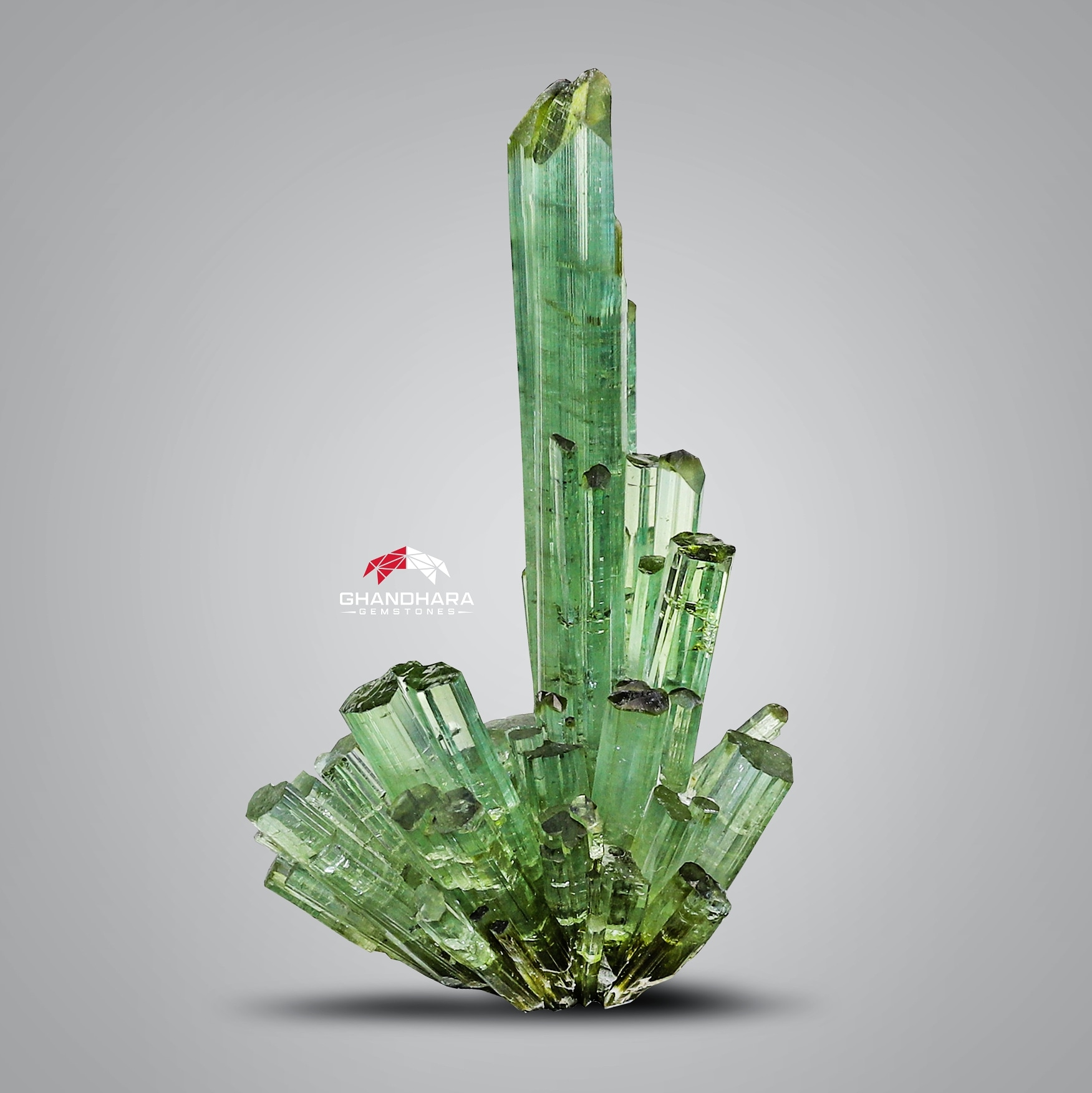
Tourmaline mineral specimens are best selected by comparing natural crystal form, color, zoning, surface striations, transparency, termination quality, matrix relationships and visible condition rather than choosing according to size or intensity of color alone. Tourmaline is a mineral group with unusually diverse chemistry, and that variation produces one of the widest color ranges encountered among familiar gem minerals. Natural crystals may appear green, pink, red, blue, brown, yellowish, near-black or distinctly multicolored, while individual specimens can preserve geometric growth, strong directional color and internal structures that would disappear completely if the crystal were cut.
Sidebar





The natural form is particularly important because tourmaline commonly develops elongated prismatic crystals with prominent lengthwise striations. These crystals can be compelling as isolated specimens, as groups attached to matrix or as multicolored pieces whose zoning records changes during growth. Buyers whose priority is a polished jewelry stone can compare tourmaline gemstones, while cutters who want unpolished material for lapidary work may prefer rough tourmaline. A mineral specimen deserves a different buying approach because the goal is to preserve the crystal's geological architecture rather than estimate how much faceted weight can be recovered from it.
Tourmaline Crystal Form: Why Prismatic Growth and Natural Striations Matter
Tourmaline crystallizes in the trigonal system and frequently develops elongated prisms that can appear almost three-sided in cross-sectional character. One of its most recognizable surface features is the presence of longitudinal striations running parallel to the length of the crystal. Those lines are part of the natural growth habit and should not be mistaken for scratches simply because they create a textured surface.
A well-developed specimen may show clearly defined prism faces, an intact termination and consistent striation along much of the crystal length. Other pieces can be more complex, with multiple crystals growing together or with portions embedded in host rock. Neither type is inherently superior. An isolated crystal makes the morphology easy to study, while a matrix specimen can preserve relationships that reveal more about the environment in which the tourmaline formed.
Natural contact faces also deserve careful interpretation. A crystal that grew against another mineral may have a flattened or irregular area that was never freely developed, and that geological contact should be distinguished from later mechanical damage. Fresh chips usually interrupt an established edge or termination and expose a different broken surface. The most useful comparison therefore considers whether the specimen retains enough of its original shape for its natural growth to remain visually clear.
Tourmaline Color Range: Green, Pink, Blue, Red and Dark Crystal Specimens
Tourmaline's chemistry produces an unusually wide range of colors, and specimens can differ so dramatically that they may appear unrelated at first glance. Green and pink are familiar collector colors, while red tourmaline can approach rubellite-like tones and blue material can extend into attractive blue-green hues. Brown and very dark tourmalines are also important natural members of the group, and some crystals contain several colors within a single uninterrupted growth.
Color should be evaluated with crystal thickness and lighting in mind. A dark green or brown crystal may reveal significantly lighter color around its edges when illuminated from behind, while a pastel pink crystal can appear stronger where the prism becomes thicker. Because tourmaline is pleochroic, color and saturation may also vary according to viewing direction, so one photograph cannot always represent the complete appearance of the specimen.
The mineral's wide chemical and optical variation is easier to understand when the relevant tourmaline specifications are considered alongside the individual crystal. For specimen buying, however, color should remain part of a complete evaluation that includes morphology, zoning, transparency, surface quality and preservation rather than functioning as a standalone grade.
Color-Zoned Tourmaline Crystals: Reading Natural Growth Through Multiple Colors
Color zoning is one of the most visually distinctive characteristics a tourmaline specimen can preserve. A crystal may change gradually from one hue to another along its length, show sharply defined zones, or contain contrasting colors arranged through its interior. These patterns result from changes in chemical conditions during crystal growth and can make an uncut specimen especially informative.
Pink-and-green combinations are among the best-known examples, but tourmaline zoning is not limited to one pairing or arrangement. Some crystals contain darker cores and lighter outer areas, while others develop successive zones that become visible across a broken end or transparent termination. In a natural mineral specimen, these transitions can be more interesting than uniform color because they preserve part of the crystal's growth history.
The same color behavior responsible for sought-after bi-color tourmaline becomes especially striking when it remains visible within the original crystal form. A collector may therefore reasonably prefer a clearly zoned specimen over a more uniformly saturated crystal, even if the latter might be considered easier to cut into conventional gemstones.
Tourmaline Transparency and Inclusions: Why Internal Features Can Add Character
Tourmaline crystals can range from transparent to translucent and effectively opaque, depending on composition, inclusions and color depth. Transparent specimens allow the viewer to see internal zoning, growth structures and mineral inclusions through natural crystal faces, while darker or more included pieces may rely more heavily on surface form and luster for their visual impact.
Inclusions should not automatically be treated as defects in a mineral specimen. Internal tubes, mineral crystals, fluid-related features and growth patterns can contribute geological interest, particularly when they can be observed without polishing the stone. What matters more from a preservation standpoint is whether a fracture reaches the surface or divides a projecting crystal in a way that increases vulnerability.
This distinction is important because specimen quality does not follow the same clarity logic as a faceted gemstone. A transparent tourmaline crystal with no internal features may be beautiful, but an included crystal with exceptional zoning, a strong termination and an interesting matrix relationship can be equally compelling for a collector. The correct choice depends on which natural characteristics the buyer wants the specimen to preserve.
Tourmaline Matrix Specimens: How Host Rock Changes the Complete Composition
Tourmaline frequently occurs with matrix, and the host rock can transform a single crystal into a more complete geological display. Contrasting matrix can make pink, green or black tourmaline stand out visually, while associated minerals may provide clues to the geological environment in which the crystals developed.
The amount of matrix is less important than how effectively it supports the tourmaline. A large host rock containing one partially obscured crystal may have less display impact than a compact matrix covered with several sharply formed prisms. Conversely, a single large crystal positioned prominently on matrix can create an exceptionally strong composition when its termination and major faces remain visible.
Stability should be assessed alongside appearance. Projecting crystals attached through narrow bases can be vulnerable during transport and handling, and the matrix itself may be softer or more fractured than the tourmaline. A specimen is therefore only as mechanically secure as its weakest component, regardless of the hardness of the main crystal.
Buyers comparing tourmaline with other mineral specimens and crystals can use these differences in matrix, growth habit and crystal geometry to decide whether they prefer an isolated crystal, a densely populated cluster or a geological association showing several minerals together.
Tourmaline Hardness and Durability: What Mineral Collectors Should Protect
Tourmaline generally measures about 7 to 7.5 on the Mohs hardness scale, giving intact surfaces useful resistance to ordinary scratching. Its overall durability is good enough for widespread jewelry use, but natural crystal specimens still require careful handling because projecting terminations, internal fractures and narrow matrix attachments can break under impact.
Hardness should therefore not be confused with indestructibility. A long tourmaline crystal creates leverage when pressure is applied near its termination, and a seemingly minor impact can damage the base if the crystal projects far from the matrix. Surface-reaching fractures can create additional weak points, particularly where they intersect natural crystal edges.
Heat deserves caution as well. Tourmaline is generally stable under normal conditions, but excessive heat can damage some stones, and color produced or modified by irradiation can be affected by heat or strong light. Routine care should consequently emphasize gentle cleaning and stable storage rather than aggressive methods. The practical recommendations under gemstone care are especially relevant when a specimen combines tourmaline with a more delicate matrix or associated mineral.
Natural Tourmaline, Treatments and the Limits of Visual Identification
A natural tourmaline crystal formed geologically, but natural origin does not by itself establish that every aspect of its present color is untreated. Heating and irradiation are relevant within parts of the tourmaline market, and treatment can sometimes alter or improve color while leaving the mineral itself natural.
For mineral collectors, this distinction may matter more strongly when the goal is to preserve a specimen as close as possible to its mined state. An unpolished surface does not automatically prove an absence of treatment, just as strong color cannot reveal its history without additional evidence.
Tourmaline's broad chemistry also makes precise species identification more complicated than simply assigning a name according to visible color. Elbaite, dravite and other tourmaline-group species can overlap in appearance, while descriptive terms such as green or pink tourmaline do not necessarily establish exact mineral composition. When identification is central to a purchase, Gandhara Gems' authenticity guarantee provides relevant purchasing context, and more advanced testing may be appropriate for particularly significant specimens.
Tourmaline Crystal Size: Why Length and Diameter Matter More Than Gross Weight
Tourmaline's elongated crystal habit makes physical dimensions especially useful when comparing specimens online. A crystal may have impressive total weight because it is thick and compact, while another may be significantly longer but narrower and therefore visually more dramatic despite carrying less mass.
Length, width and thickness help a collector understand the specimen's real scale and how it will fit into a cabinet or display. With matrix specimens, the dimensions of the complete piece should also be considered separately from the size of the focal tourmaline crystal. A broad host rock may greatly increase the overall footprint without increasing the size of the main crystal.
The physical relationship between these measurements can also affect stability. Tall narrow crystals may need more protected display positions than compact pieces, particularly when the natural base is irregular. Choosing according to actual dimensions rather than weight alone therefore improves both aesthetic planning and long-term preservation.
Buying Tourmaline Mineral Specimens Online: Compare the Complete Natural Crystal
A useful online comparison begins with the natural form of the focal crystal, then moves through color, zoning, transparency, striations, inclusions, matrix and visible condition. Several viewing angles are valuable because elongated tourmaline can hide fractures or contact surfaces behind a dominant prism face, while pleochroism may cause the apparent color to change as the crystal is rotated.
The strongest specimen depends on the collecting objective. A buyer focused on classic morphology may prefer a sharply terminated single crystal with strong longitudinal striations, while another may value a multicolored crystal whose zoning tells a more complex growth story. Matrix collectors may reasonably prioritize composition and associated minerals over perfect termination.
Because natural specimens are individually formed and rarely interchangeable, delivery conditions deserve consideration as part of the purchase. Gandhara Gems' shipping information is particularly relevant when a specimen contains projecting crystals or delicate attachments that require careful protection during transport.
Tourmaline Mineral Specimen FAQs
What makes a high-quality tourmaline mineral specimen?
A strong tourmaline mineral specimen usually combines clearly recognizable natural crystal form with appealing color, preserved surfaces, useful termination quality and an overall composition suited to the buyer's collecting goals. An isolated prism may be desirable because its striations and geometry are easy to study, while a matrix piece can be more compelling when several crystals are arranged naturally with contrasting associated minerals. Size can increase visual impact, but it should not outweigh preservation, color zoning or the structural integrity of the focal crystal.
Why do some tourmaline crystals contain several colors?
Tourmaline's chemistry can change while a crystal grows, allowing different zones to develop under changing geological conditions. These variations may produce pink and green sections, darker cores, lighter ends or other multicolored combinations within one uninterrupted crystal. For a collector, well-defined zoning can increase visual and geological interest because the specimen preserves those changes directly rather than reducing them to a single face-up color through cutting.
Are the vertical lines on tourmaline crystals scratches or damage?
Many tourmaline crystals naturally develop pronounced longitudinal striations along their prism faces, so parallel lines running the length of a crystal are often genuine growth features rather than damage. Fresh scratches usually cut across the natural pattern or show a distinctly different surface character. When condition matters, buyers should compare multiple photographs and focus particularly on broken terminations, chipped edges and fresh fracture surfaces rather than assuming every textured line represents wear.
Are transparent tourmaline crystals better than opaque specimens?
Transparency can be attractive because it reveals zoning and internal inclusions, but it is not a universal measure of specimen quality. Dark, translucent or nearly opaque tourmaline can have excellent crystal form, strong natural luster and impressive matrix associations that make it highly collectible. The most meaningful comparison considers transparency together with morphology, color, surface preservation and the type of specimen the buyer wants to add to the collection.
Is tourmaline durable enough for open display?
Tourmaline's Mohs hardness of about 7 to 7.5 gives it good scratch resistance, but elongated crystals and projecting terminations can still chip or break if struck. Matrix specimens may be especially vulnerable where crystals attach through narrow bases or where the host rock is fragile. A stable shelf or cabinet position that prevents the specimen from tipping or contacting neighboring minerals is therefore more important than relying on hardness alone.
Does a natural tourmaline crystal always mean untreated color?
No. Natural refers to geological origin, while treatment describes what may have happened after mining. Heating and irradiation can be relevant in parts of the tourmaline market, so an uncut or naturally shaped crystal does not automatically establish untreated color. Buyers who consider treatment history important should evaluate available disclosure rather than relying only on appearance.
Choose Tourmaline Minerals by Natural Form, Color Zoning and Preservation
Compare the current Tourmaline Minerals by prism development, natural striations, hue, pleochroic behavior, color zoning, transparency, inclusions, matrix relationships and actual physical dimensions. A sharply formed single crystal may be the strongest choice when morphology is the priority, while a zoned or matrix specimen can preserve a more complex geological story. Rather than automatically selecting the largest or most vivid crystal, choose the individual tourmaline whose natural structure, color character and state of preservation best suit the mineral collection or display you want to build.

Recently Viewed Products
Example product title
- $19.99
- $19.99
- Unit price
- / per
Example product title
- $19.99
- $19.99
- Unit price
- / per
Example product title
- $19.99
- $19.99
- Unit price
- / per
Example product title
- $19.99
- $19.99
- Unit price
- / per
Example product title
- $19.99
- $19.99
- Unit price
- / per
Example product title
- $19.99
- $19.99
- Unit price
- / per
Example product title
- $19.99
- $19.99
- Unit price
- / per
Example product title
- $19.99
- $19.99
- Unit price
- / per
Example product title
- $19.99
- $19.99
- Unit price
- / per
Example product title
- $19.99
- $19.99
- Unit price
- / per
- Choosing a selection results in a full page refresh.


