

-
4.55 Carats Opalescent Bicolor Zircon Cushion Modified Cut African Gemstone - Bicolor
4.55 Carats Opalescent Bicolor Zircon featuring a cushion shape and modified cut. Sourced from Africa, this untreated gemstone has VS clarity. Its opalescent bicolor appearance offers a distinctive centerpiece for a personal pendant, ring, or bespoke jewelry design. Product Information: Gemstone Bicolor Zircon...- $820.00
$0.00- $820.00
- Unit price
- per
-
Bicolor
-
2.53 Carats Vivid Yellow Zircon Pear Faceted Madagascar Gemstone - Yellow
2.53 Carats Vivid Yellow Zircon featuring an elegant pear shape and faceted cut. Sourced from Madagascar, this untreated gemstone has VS clarity. Its vivid yellow color makes it a distinctive choice for a personal pendant, ring, or custom jewelry design. Product Information: Gemstone...- $170.00
$0.00- $170.00
- Unit price
- per
-
Yellow
-
2.91 carats Bright Yellow Zircon Stone Oval Faceted Natural Madagascar Gemstone - Yellow
2.91 Carats Natural Bright Yellow Zircon featuring an elegant oval faceted cut and lively natural color. Sourced from Madagascar, this untreated gemstone has SI clarity and excellent brilliance, making it a beautiful choice for rings, pendants, bespoke jewelry, and custom designs. Product Information:...- $159.99
$0.00- $159.99
- Unit price
- per
-
Yellow
-
2.45 carats Natural Intense Blue Zircon Stone Pear Cut Cambodian Gemstone - Tiffany_blue
This 2.45 carats Natural Intense Blue Zircon is beautifully crafted in an elegant pear cut, showcasing vivid blue color with exceptional fire and brilliance. Sourced from Cambodia, this natural gemstone is prized for its remarkable sparkle, clarity, and timeless appeal. Its vibrant hue and...- $175.00
$0.00- $175.00
- Unit price
- per
-
Tiffany_blue
-
7.29 carats Peachy Red Zircon Stone Cushion Cut Natural Sri Lankan Gemstone - Brownish Red
A breathtaking fusion of warm peach and glowing red hues, this 7.29 carat Zircon radiates timeless brilliance. Expertly cushion cut to capture every flicker of light, this natural treasure from Sri Lanka exudes charm and sophistication. Known for its exceptional sparkle and vibrant energy,...- $950.00
$0.00- $950.00
- Unit price
- per
-
Brownish Red
-
6.32 carats Red Zircon Stone Emerald Cut Natural Sri Lankan Gemstone - Brownish Red
Unveil the fiery brilliance of this 6.32-carat Red Zircon, a gem that embodies passion and timeless beauty. Expertly emerald cut to emphasize its depth and clarity, this natural treasure from Sri Lanka radiates intense red hues and dazzling sparkle. Known for its brilliance and...- $650.00
$0.00- $650.00
- Unit price
- per
-
Brownish Red
-
7.08 carats Red Zircon Stone Oval Cut Natural Sri Lankan Gemstone - Brownish Red
Experience the fiery brilliance of this 7.08-carat Red Zircon, expertly oval cut to reveal its natural radiance and depth. Originating from the gem-rich lands of Sri Lanka, this gemstone glows with a warm, intense red hue that symbolizes passion and vitality. Perfect for bespoke...- $1,050.00
$0.00- $1,050.00
- Unit price
- per
-
Brownish Red
-
5.78 carats Peachy Red Zircon Stone Cushion Cut Natural Sri Lankan Gemstone - Brownish Red
Experience the warm brilliance of this 5.78 carats Peachy Red Zircon, a natural gemstone sourced from the heart of Sri Lanka. With its rich peach-red hue and fiery sparkle, this gemstone radiates luxury and sophistication. Expertly cushion cut to maximize brilliance and depth, it...- $810.00
$0.00- $810.00
- Unit price
- per
-
Brownish Red
-
5.94 carats Yellowish Orange Zircon Stone Cushion Cut Natural Sri Lankan Gemstone - Orange Yellow
Elevate your collection with this dazzling 5.94 carat Yellowish Orange Zircon, expertly crafted in a brilliant cushion cut to maximize fire and sparkle. Naturally sourced from the renowned gem mines of Sri Lanka, this gemstone displays a warm fusion of golden-yellow and fiery orange...- $575.00
$0.00- $575.00
- Unit price
- per
-
Orange Yellow
-
7.15 carats Peachy Red Zircon Stone Cushion Cut Natural Sri Lankan Gemstone - Brownish Red
A breathtaking fusion of warm peach and glowing red hues, this 7.15 carat Zircon radiates timeless brilliance. Expertly cushion cut to capture every flicker of light, this natural treasure from Sri Lanka exudes charm and sophistication. Known for its exceptional sparkle and vibrant energy,...- $710.00
$0.00- $710.00
- Unit price
- per
-
Brownish Red
-
6.05 carats Yellow Zircon Stone Heart Cut Natural Sri Lankan Gemstone - Yellowish Golden
This radiant 6.05 carat Yellow Zircon glows with warmth and brilliance, expertly crafted in a charming heart cut. Sourced from Sri Lanka, this natural gemstone exhibits a vivid golden-yellow hue, exceptional clarity, and remarkable sparkle that rivals even diamonds. Its heart shape symbolizes love...- $550.00
- $550.00
- Unit price
- per
-
Yellowish Golden
-
12.19 carats Champagne Color Zircon Stone Cushion Cut Natural African Gemstone - Yellow
This impressive 12.19 carat Champagne Color Zircon is a natural gemstone from Africa, admired for its warm golden-brown hue and remarkable brilliance. Expertly cut in a cushion shape, it maximizes sparkle, depth, and fire, showcasing the gem’s natural radiance. Zircon, often treasured for its...- $1,830.00
- $1,830.00
- Unit price
- per
-
Yellow
-
3.38 carats Fine Quality Green Zircon Stone Cushion Cut Natural Sri Lankan Gemstone - Green
This stunning 3.38 carat Green Zircon is a fine-quality natural gemstone sourced from the famed gem mines of Sri Lanka. Expertly cut into a classic cushion shape, it radiates a vivid green hue enhanced by zircon’s exceptional brilliance and diamond-like fire. Known for its...- $550.00
$0.00- $550.00
- Unit price
- per
-
Green
-
4.88 carats Tiffany Blue Zircon Stone Oval Cut Natural Cambodian Gemstone - Tiffany_blue
This exquisite 4.88 carat Tiffany Blue Zircon gemstone is a stunning example of natural beauty, sourced from the rich lands of Cambodia. Expertly cut in a oval shape, this gemstone showcases a brilliant play of light, with its vibrant blue hue captivating the eye....- $650.00
- $650.00
- Unit price
- per
-
Tiffany_blue
-
5.06 carats Blue Zircon Stone Cushion Cut Natural Cambodian Gemstone - Tiffany_blue
This exquisite 5.06 carat Blue Zircon gemstone is a stunning example of natural beauty, sourced from the rich lands of Cambodia. Expertly cut in a cushion shape, this gemstone showcases a brilliant play of light, with its vibrant blue hue captivating the eye. The...- $650.00
$0.00- $650.00
- Unit price
- per
-
Tiffany_blue
-
4.48 carats Blue Zircon Stone Cushion Cut Natural Cambodian Gemstone - Tiffany_blue
This exquisite 4.48 carat Blue Zircon gemstone is a stunning example of natural beauty, sourced from the rich lands of Cambodia. Expertly cut in a cushion shape, this gemstone showcases a brilliant play of light, with its vibrant blue hue captivating the eye. The...- $600.00
$0.00- $600.00
- Unit price
- per
-
Tiffany_blue
-
5.58 carats Tiffany Blue Zircon Stone Oval Cut Cambodian Gemstone - Tiffany_blue
This exquisite 5.58 carat Tiffany Blue Zircon gemstone is a stunning example of natural beauty, sourced from the rich lands of Cambodia. Expertly cut in a oval shape, this gemstone showcases a brilliant play of light, with its vibrant blue hue captivating the eye....- $700.00
$0.00- $700.00
- Unit price
- per
-
Tiffany_blue
-
4.65 carats Blue Zircon Stone Cushion Cut Natural Cambodian Gemstone - Tiffany_blue
This exquisite 4.65 carat Blue Zircon gemstone is a stunning example of natural beauty, sourced from the rich lands of Cambodia. Expertly cut in a cushion shape, this gemstone showcases a brilliant play of light, with its vibrant blue hue captivating the eye. The...- $770.00
$858.00- $770.00
- Unit price
- per
-
Tiffany_blue
-
4.61 carats Blue Zircon Stone Pear Cut Natural Cambodian Gemstone - Tiffany_blue
The 4.61 carat Blue Zircon stone is a remarkable gemstone, known for its captivating beauty and vibrant color. Originating from the renowned gem mines of Cambodia, this natural gemstone displays a rich, deep blue hue that is highly sought after in the world of...- $605.00
$676.00- $605.00
- Unit price
- per
-
Tiffany_blue
-
5.40 carats Blue Zircon Stone Trillion Cut Natural Cambodian Gemstone - Tiffany_blue
The 5.40 carat Blue Zircon stone is a remarkable gemstone, known for its captivating beauty and vibrant color. Originating from the renowned gem mines of Cambodia, this natural gemstone displays a rich, deep blue hue that is highly sought after in the world of...- $637.00
- $637.00
- Unit price
- per
-
Tiffany_blue
-
Yellowish Golden Natural Zircon Pair - Yellowish Golden
Yellowish Golden Natural Zircon Pair, available for sale at wholesale price, natural high quality 3.60 carats (1.74 carats each) VVS clarity, certified Zircon from Combodia. Product Information: Gemstone Name Yellowish Golden Natural Zircon Pair Weight 3.60 carats (1.74 carats each) Dimensions 7.1 x 7.1...- $215.00
- $215.00
- Unit price
- per
-
Yellowish Golden
-
Buy 7.15 Carat Natural Round Zircons Lot - Orange
Buy 7.15 Carat Natural Round Zircons Lot at wholesale price from Pakistan with Eye Clean Clarity. Product Information: Gemstone Name Natural Round Zircons Lot Weight 7.15 carats Average Weight 1.70 carats Dimensions 6.90 x 4.31 mm Origin Pakistan Clarity Eye Clean Treatment None Shipping:...- $380.00
- $380.00
- Unit price
- per
-
Orange
Free Shipping on order over $80
100% Authentic & Certified
Save Big in 2026
Zircon Gemstones
Zircon gemstones are best selected by comparing natural color, brilliance, clarity, cut quality, carat weight, actual millimeter dimensions and intended jewelry use rather than by choosing the largest stone or assuming that every bright blue zircon represents the same quality. Zircon is a natural zirconium silicate gemstone with the formula ZrSiO₄ and should not be confused with cubic zirconia, a laboratory-manufactured zirconium oxide simulant. Natural zircon has been known for centuries and can show exceptionally strong brilliance and dispersion, giving well-cut stones flashes of spectral color that can be striking even when the body color is relatively subtle.

Sidebar


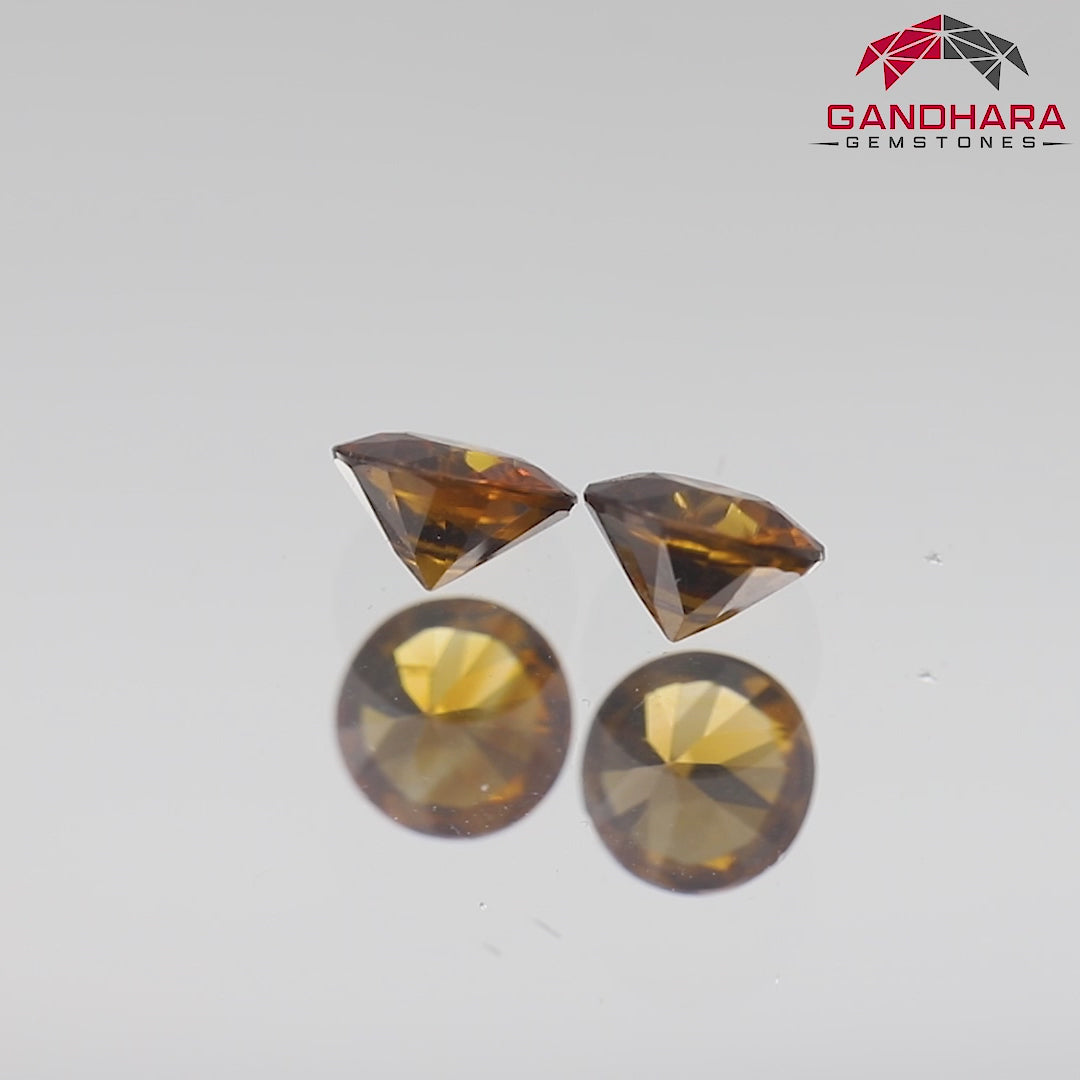


The species occurs in blue, colorless, yellow, orange, red, brown and green, with some colors much more familiar in the gem trade than others. Strong birefringence can cause facet edges viewed through the stone to appear doubled, particularly in certain orientations, which gives zircon an optical character unlike many other transparent gemstones. Buyers comparing zircon with other loose gemstones should therefore judge the actual stone's color, optical performance and durability rather than evaluating it as a substitute for diamond or another gem.
Zircon Color Quality: Blue, Colorless, Golden and Earth-Toned Stones
Blue is one of the most commercially familiar zircon colors, ranging from pale sky blue through brighter blue and blue-green tones. Colorless zircon can emphasize the species' high brilliance and dispersion, while yellow, orange, brown and reddish stones offer warmer appearances that can look especially attractive under softer lighting. Green zircon also occurs naturally, though its appearance and gemological characteristics can differ considerably from the more familiar heated blue material.
Color should be assessed in combination with tone. A blue zircon can be strongly saturated yet appear too dark if the stone is unusually deep, while a paler stone may return enough light to look much brighter from the top. Warm-colored stones present the same trade-off because additional depth can enrich body color while reducing visible brilliance if the pavilion becomes excessive.
The strongest buying choice is therefore not automatically the darkest stone. A medium-toned zircon with lively face-up color, good symmetry and strong light return can create more visual impact than a deeper stone whose body color overwhelms its optical performance.
Zircon Brilliance and Dispersion: Why Well-Cut Stones Can Look Exceptionally Lively
Zircon is known for high refractive index and notable dispersion, allowing a properly cut stone to return strong white brilliance along with flashes of spectral color. These properties can be especially obvious in colorless and lighter-colored zircons, although vivid blue stones can also show considerable sparkle when proportions are balanced.
Cut quality determines whether that optical potential becomes visible. A stone cut too shallowly may show a transparent window through its center, while excessive depth can trap weight beneath the girdle without producing a proportionate increase in brightness. Symmetry, facet alignment and polish all influence whether the light performance looks crisp or uneven.
Brilliance should still be considered alongside body color rather than used as the only standard. Some buyers prefer a slightly deeper warm-colored zircon whose richness matters more to them than maximum fire, while others favor a brighter stone that flashes strongly in movement. The important point is that the cut should support the character of the individual gemstone.
Zircon Birefringence: Why Facet Edges Can Appear Doubled
Natural zircon is doubly refractive, meaning light entering the gemstone can separate into two rays traveling at different speeds. In strongly birefringent directions, this can make pavilion facet edges appear doubled when viewed through the table or crown.
This effect is a normal optical property rather than evidence of poor cutting or a defective stone. Skilled cutters orient zircon carefully because the direction of observation can influence how obvious the doubling becomes and how cleanly the finished gem presents face-up.
For buyers, noticeable facet doubling can even become part of zircon's identity. It helps separate natural zircon optically from many singly refractive gemstones and from cubic zirconia, though proper identification should still rely on complete gemological evidence rather than one visual feature.
Zircon Clarity: Eye-Clean Appearance and Natural Internal Features
Many faceted zircons can appear relatively clean to the unaided eye, allowing brilliance and color to dominate. Natural inclusions may still include mineral crystals, needles, growth features, healed fractures and other internal characteristics, and their importance depends largely on visibility and structural position.
A small inclusion near the girdle may have little practical effect, while a dark crystal or reflective fracture directly beneath the table can interrupt brilliance more strongly. Surface-reaching fractures deserve particular attention because zircon can be brittle, and structural weakness matters more in jewelry than microscopic perfection.
Buyers should therefore judge whether inclusions are noticeable at ordinary viewing distance and whether they threaten durability. A visually clean stone with a minor internal feature can still be an excellent choice when color, cut and proportions are strong.
Zircon Cut Quality: Managing High Brilliance Without Hiding Weight
Round, oval, cushion and mixed cuts are particularly effective for zircon because they can make good use of its strong refractive properties. Brilliant-style pavilion facets encourage lively reflections, while the crown can distribute dispersion across the face of the gemstone.
Cutters also need to manage zircon's brittleness and directional optical behavior. Preserving maximum rough weight is not always the same as producing the most attractive finished stone, especially when extra pavilion depth makes the stone look smaller from the top or creates dark zones through the center.
A well-proportioned zircon should look balanced in motion rather than brilliant only from one carefully chosen angle. Buyers can compare symmetry, face-up spread and brightness together to decide whether the cut makes efficient use of the stone's weight.
Zircon Carat Weight vs Millimeter Size
Carat weight measures mass rather than visible diameter, and zircon has relatively high density compared with many familiar gemstones. A zircon can therefore weigh more than a similarly sized quartz or beryl while presenting a smaller face-up area.
This difference makes millimeter dimensions essential when choosing a stone for jewelry. An oval zircon weighing several carats may still fit a relatively compact setting if much of its mass is concentrated in depth, while a well-spread stone of slightly lower weight can appear larger from above.
Length, width and depth should always be considered together. Buyers commissioning a custom setting have greater flexibility, but those fitting a gemstone into an existing mount should rely on dimensions rather than carat weight to determine compatibility.
Blue Zircon and Heat Treatment: Natural Stone Does Not Always Mean Untreated Color
Heat treatment is common in the zircon trade, particularly for producing or modifying blue and colorless appearances from certain brownish rough. A heated zircon can still be a natural gemstone because treatment changes the appearance of a naturally formed crystal rather than creating the crystal itself.
Natural and untreated therefore mean different things. Buyers who specifically want unheated zircon should rely on appropriate disclosure or gemological evidence rather than assuming that natural origin establishes treatment history.
Treatment does not remove the importance of ordinary quality factors. A heated blue zircon still needs attractive hue, sound clarity, effective cutting and good condition to make a satisfying purchase.
Zircon Durability: Hardness Does Not Prevent Facet-Edge Wear
Zircon generally falls around Mohs 6 to 7.5 depending partly on its structural condition, which gives it moderate resistance to scratching. The mineral can nevertheless be brittle, and facet edges may show abrasion or chipping after prolonged wear if the stone receives repeated knocks.
This distinction is important in ring settings. Zircon can certainly be worn in rings, but a protected mounting and reasonable care make more sense than exposing sharp edges to continuous impact. Pendants and earrings are generally more forgiving because they experience fewer direct blows.
Gentle handling is especially important during cleaning. The guidance under gemstone care is relevant because sudden temperature changes, aggressive cleaning and unnecessary impact should be avoided even when a gemstone looks optically bright and robust.
Zircon vs Cubic Zirconia: Natural Gemstone and Synthetic Simulant Are Different
Zircon and cubic zirconia are often confused because of their similar names, but they are entirely different substances. Zircon is a naturally occurring zirconium silicate mineral, while cubic zirconia is a manufactured zirconium oxide widely used as a diamond simulant.
Natural zircon has its own crystal structure, inclusions, optical behavior and geological history. Cubic zirconia is singly refractive and produced under controlled laboratory conditions, while zircon is doubly refractive and commonly shows characteristic facet doubling.
The similarity of their names should therefore not affect how zircon is evaluated. The gemstone deserves to be considered as its own species rather than as an imitation of another stone.
Zircon Mineral Crystals vs Faceted Zircon Gemstones
Natural zircon crystals can be attractive mineral specimens even when they are too included, fractured or opaque for faceting. These specimens preserve tetragonal crystal habit, natural surfaces, matrix and geological context, while finished gemstones emphasize transparency, body color and optical performance.
Collectors interested in uncut morphology can compare zircon mineral specimens, where natural crystal form remains intact. A transparent complete crystal should not automatically be regarded as cutting rough because removing its faces can destroy mineralogical features that cannot be restored.
Faceted zircon gemstones satisfy a different purpose. They allow buyers to appreciate brilliance, dispersion and polished color in ways that may remain hidden inside an uncut crystal.
Zircon as a December Birthstone
Zircon is traditionally recognized as one of December's birthstones alongside turquoise and tanzanite. Its wide color range allows birthstone jewelry to move beyond blue, although blue zircon is particularly familiar in modern December designs.
The site's discussion of December birthstones places zircon alongside these other traditions, while the actual purchase should still be guided by gemstone quality and jewelry suitability rather than the calendar association alone.
Someone choosing zircon for a birthstone ring, pendant or earrings should pay the same attention to cut, dimensions and durability that they would for any other natural gemstone. Symbolic significance does not change the physical behavior of the stone.
Zircon Authenticity and Identification
Natural zircon can resemble several other transparent gemstones depending on color, but its high refractive index, strong birefringence, dispersion and other diagnostic properties provide useful identification evidence. Exact determination is especially important because the name can be confused commercially with cubic zirconia.
Gandhara Gems' authenticity guarantee provides relevant purchasing context where identity matters. Significant stones may also justify independent gemological documentation when treatment, natural origin or exact gemstone identification materially influences the decision.
Buyers should preserve any accompanying reports or disclosure information because those records remain useful long after the gemstone has been mounted.
Buying Zircon Gemstones Online: Compare Real Color, Dimensions and Condition
A careful online comparison begins with face-up color and light performance, followed by clarity, cut symmetry, carat weight and exact millimeter dimensions. Side photographs are particularly useful because they reveal depth and help show whether the apparent carat size is distributed efficiently.
Close-up images should also be examined for abrasion along facet junctions, especially on previously handled or older stones. A bright photograph can hide minor edge wear when reflections are strong, so condition deserves independent attention.
Choose the current Zircon Gemstone whose color, brilliance, dimensions and physical condition fit the intended jewelry rather than allowing maximum carat weight to control the purchase.
Zircon Gemstone FAQs
Is zircon a natural gemstone?
Yes. Zircon is a naturally occurring zirconium silicate mineral that forms geologically and has been used as a gemstone for centuries. It should not be confused with cubic zirconia, which is manufactured. Natural zircon can still undergo heat treatment, so natural origin and untreated status should be considered separately.
Why does zircon show so much brilliance?
Zircon has a relatively high refractive index and noticeable dispersion, allowing a well-cut stone to return strong white light and spectral flashes. The effect depends heavily on proportions and polish, so an excellent piece of rough can still look dull if the cut creates excessive windowing or darkness.
Why do some zircon facet edges look doubled?
Zircon is doubly refractive, so light can separate into two rays as it travels through the gemstone. This can make pavilion facet edges appear doubled when viewed through the crown in certain directions. The effect is a normal optical characteristic of zircon rather than a cutting defect.
Is blue zircon naturally blue?
Blue zircon exists in the market largely through heat treatment of suitable natural rough, although the underlying zircon itself is naturally formed. Buyers specifically seeking untreated color should therefore rely on disclosure or suitable laboratory evidence rather than assuming that all natural blue zircon is unheated.
Is zircon durable enough for a ring?
Zircon can be worn in rings, but its brittleness and potential for facet-edge abrasion make a protective setting and sensible wearing habits advisable. Pendants and earrings expose the stone to less mechanical impact. A ring intended for frequent wear should shield vulnerable edges and avoid activities likely to produce hard knocks.
Why can a heavy zircon look smaller than expected?
Zircon has relatively high density, so more weight can be concentrated into a given volume than in many lower-density gemstones. Deep cutting can further increase the carat figure without increasing face-up spread. Millimeter measurements are therefore essential when comparing visible size.
Choose Zircon Gemstones by Color, Brilliance and Face-Up Performance
Compare the current Zircon Gemstones by natural color, brightness, dispersion, clarity, cut symmetry, carat weight, actual dimensions and facet condition. Give particular attention to how much visible size and brilliance the cut produces rather than assuming that a heavier stone must offer greater visual impact. Choose the individual zircon whose optical character, proportions and durability best fit your ring, pendant, earrings or gemstone collection.

Recently Viewed Products
Example product title
- $19.99
- $19.99
- Unit price
- / per
Example product title
- $19.99
- $19.99
- Unit price
- / per
Example product title
- $19.99
- $19.99
- Unit price
- / per
Example product title
- $19.99
- $19.99
- Unit price
- / per
Example product title
- $19.99
- $19.99
- Unit price
- / per
Example product title
- $19.99
- $19.99
- Unit price
- / per
Example product title
- $19.99
- $19.99
- Unit price
- / per
Example product title
- $19.99
- $19.99
- Unit price
- / per
Example product title
- $19.99
- $19.99
- Unit price
- / per
Example product title
- $19.99
- $19.99
- Unit price
- / per
- Choosing a selection results in a full page refresh.


