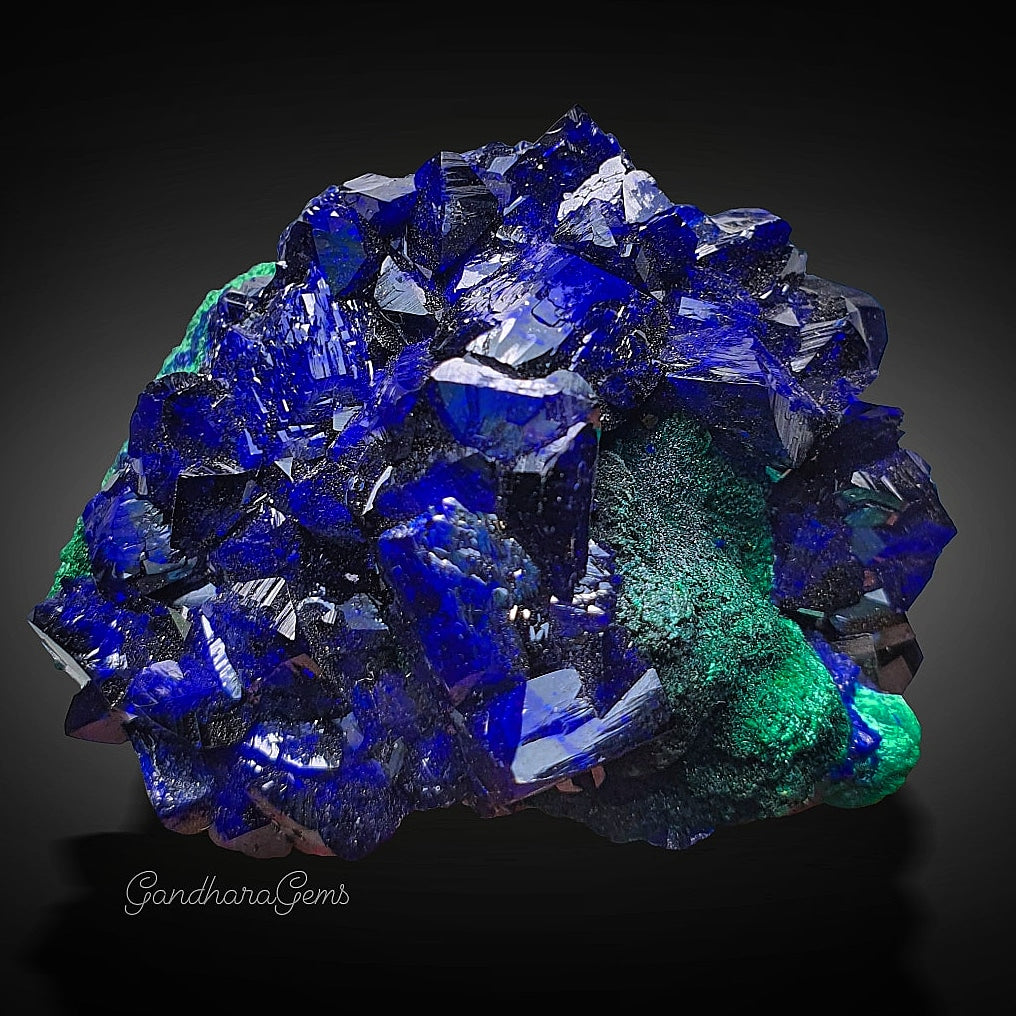
Azurite Minerals

Azurite minerals are best selected by comparing natural azure-blue color, crystal form, surface luster, matrix relationships, malachite association, physical dimensions and visible preservation rather than by choosing the darkest blue or largest specimen automatically. Azurite is a copper carbonate hydroxide with the formula Cu₃(CO₃)₂(OH)₂ and commonly forms in the oxidized zones of copper deposits. Its intense blue color can range from lighter blue through saturated royal and deep azure tones, while natural specimens may occur as individual crystals, clustered growth, botryoidal masses or complex combinations with green malachite and other secondary copper minerals.

Azurite Malachite for sale and jewelry

The strongest collector specimen is not necessarily the one carrying the most blue mass. A relatively small azurite crystal with well-developed faces, strong vitreous luster and intact terminations can communicate the mineral's structure more clearly than a heavier specimen consisting largely of broken or massive material. Within the wider selection of mineral specimens and crystals, azurite stands out because color, crystal quality and copper-mineral associations can all contribute substantially to the character of one specimen.

Azurite Blue Color: Why Saturation Should Be Judged With Crystal Form

Azurite is famous for its rich blue color, and that color can become exceptionally saturated in well-crystallized specimens. Thin or translucent areas may appear somewhat lighter, while thick crystals or dense aggregates can look almost black-blue under limited illumination. Strong studio lighting can reveal bright royal-blue reflections that may not appear as intense under ordinary cabinet conditions, so photographs should be considered together with luster, transparency and actual crystal thickness.

The deepest color is not automatically the best collector choice. A dark specimen can lose visual definition if individual faces are difficult to distinguish, while a slightly lighter crystal with sharp geometry and clean luster can show much more structure. The strongest pieces allow the blue color to support the crystal form rather than overwhelm it.

Color uniformity is not essential either. Natural azurite can occur with lighter growth zones, darker centers or green malachite nearby, and those variations can add geological interest when the complete specimen remains visually balanced. Buyers should therefore judge the natural composition rather than looking for a manufactured level of perfect uniformity.

Azurite Crystal Habit: Tabular, Prismatic and Complex Monoclinic Forms

Azurite crystallizes in the monoclinic system and commonly forms tabular or prismatic crystals, although equant, bladed and more complex habits can also occur. Well-developed specimens can show strong reflective faces and intricate intergrowths that make the mineral visually interesting beyond its famous color.

Crystal completeness deserves close attention because sharp edges and terminations reveal the original growth more clearly. A naturally contacted face should not automatically be classified as damage, since a neighboring mineral may have prevented that surface from developing freely. Fresh chips are different when they interrupt established edges or remove a visually important termination.

Groups of smaller crystals can be as collectible as one large crystal when the aggregate preserves clear natural form. A cluster in which several crystals point in different directions may create more visual depth than an isolated specimen, particularly when the surfaces retain strong luster and contrasting matrix remains visible.

Azurite and Malachite: Why Blue and Green Copper Minerals Often Occur Together

Azurite and malachite are both secondary copper minerals and are commonly associated in oxidized copper deposits. Their contrasting colors can make combined specimens especially distinctive, with deep blue azurite beside vivid to darker green malachite creating one of the most recognizable natural mineral pairings.

Azurite can alter to malachite under suitable geological conditions, which means some specimens preserve transitional relationships rather than two completely separate growth events. Green coatings, replacements or intergrowths can therefore become part of the specimen's mineralogical story rather than simply decorative contrast.

Collectors particularly interested in the green member of this association can compare separate malachite mineral specimens, while an azurite-malachite combination should be judged as a complete composition. The proportion of each mineral matters less than whether the blue and green areas are well preserved, clearly identifiable and naturally arranged.

Azurite Luster and Surface Preservation: Why Natural Faces Matter

Azurite commonly shows vitreous luster, and intact crystal faces can produce vivid highlights against the deep blue body color. This reflection helps reveal monoclinic geometry that might otherwise disappear into the dark saturation of thick crystals.

Surface quality is especially important because azurite is relatively soft. Abrasion can dull natural faces, while scratches or rubbed edges can reduce the crisp appearance of an otherwise attractive specimen. A lustrous smaller crystal may therefore present better than a larger piece whose important surfaces have been worn or damaged.

Natural growth textures should not be confused with later abrasion. Fine striations, uneven crystal development and contact surfaces can all form geologically, whereas random scratches and fresh chips usually cut across the natural structure. Multiple photographs under directional light make those differences easier to assess.

Azurite Hardness and Cleavage: Why Blue Crystals Need Gentle Handling

Azurite has Mohs hardness around 3.5 to 4, making it considerably softer than quartz, beryl, topaz and corundum. Its relatively low hardness means exposed crystal surfaces can scratch when they contact harder specimens, while its brittle character and cleavage make sharp edges vulnerable to impact.

A visually substantial crystal can therefore require more care than its appearance suggests. Matrix specimens should be held from a stable base rather than by projecting azurite crystals, and loose pieces should be stored so they cannot rub against harder minerals in a drawer or display case.

General gemstone care principles are useful, but azurite specimens deserve particularly conservative handling. Avoid abrasive cleaning, strong chemicals, acids, steam and ultrasonic methods, especially when a specimen contains delicate crystals or associated minerals with different physical properties.

Azurite Matrix Specimens: Host Rock Can Strengthen Both Contrast and Context

Matrix can contribute significantly to an azurite specimen when it provides visual contrast or preserves the geological environment in which the crystals developed. Pale host rock can make saturated blue crystals stand out strongly, while green malachite or other copper minerals can introduce additional color without overwhelming the focal azurite.

The amount of matrix is less important than how effectively it supports the composition. A large host rock containing one small damaged patch of azurite may offer limited display value, while a compact piece with several clearly exposed crystals can be visually stronger and easier to display.

Structural stability should be examined carefully because the host may be weaker than the azurite itself. A crystal securely attached to fractured or crumbly matrix remains vulnerable during handling and shipping, so buyers should assess the complete specimen rather than focusing only on the condition of the blue crystals.

Azurite Botryoidal and Massive Forms: Collector Quality Is Not Limited to Sharp Crystals

Although sharply crystallized azurite attracts considerable attention, the mineral can also occur in botryoidal, stalactitic and massive forms. Rounded surfaces and dense aggregates can produce rich blue color without exposing individual crystal faces clearly, creating a different type of collector specimen.

These forms should not be graded by standards intended for isolated crystals. A botryoidal specimen can be attractive because of its surface texture, color distribution and overall shape, while a massive piece may preserve interesting associations or replacement textures.

The key is to understand what the specimen naturally offers. A botryoidal piece with intact rounded surfaces should be evaluated for preservation and color, while a prismatic crystal should be judged more heavily by termination and face quality. Applying one universal standard would ignore the natural diversity of azurite growth.

Azurite Mineral Identification: Deep Blue Color Alone Is Not Sufficient

Azurite's blue is distinctive, but color alone is not enough for definitive mineral identification. Lazurite, sodalite and several other blue minerals can create superficially similar appearances in photographs, particularly when natural crystal form is absent or the specimen is massive.

Azurite's copper carbonate composition, monoclinic structure, hardness, luster and typical geological association provide a more reliable identification framework than color alone. Its common relationship with malachite can also be informative, although that association should never substitute for proper mineral identification.

Gandhara Gems' authenticity guarantee provides useful purchase context when mineral identity matters. Collectors building systematic collections should also retain reliable locality and specimen labels so the physical piece does not become separated from its geological information.

Azurite Meaning and Traditional Associations vs Mineralogical Evidence

Azurite has accumulated symbolic, artistic and cultural associations because of its intense blue color and historical use as a pigment. Those traditions can be interesting from a cultural perspective, but they should remain distinct from scientifically established mineral properties.

Mineralogically, azurite is a copper carbonate hydroxide whose collector appeal comes from color, crystallography, luster, matrix associations and geological occurrence. Claims that the mineral treats medical conditions, changes mental health or produces measurable physical healing effects are not established by those properties.

Separating symbolism from mineral science allows collectors to appreciate historical traditions without confusing personal beliefs with evidence about the specimen itself.

Azurite Dimensions and Display Scale: Why Weight Can Be Misleading

Physical measurements provide a clearer sense of specimen size than weight alone because matrix can account for much of the total mass. A heavy azurite specimen may contain a relatively small amount of visible blue mineral if most of its weight comes from host rock, while a light crystal cluster can create considerable display presence through projecting growth.

Length, width and height should therefore be reviewed together. Macro photography can make individual crystals appear much larger than they are, particularly when vivid color and reflective faces fill the frame.

Display planning also matters because projecting crystals need clearance from neighboring specimens. A compact but delicate cluster may require more protected space than a dense massive piece of similar dimensions, especially if its most attractive terminations extend beyond the main matrix.

Buying Azurite Minerals Online: Compare Color, Form, Association and Condition Together

A careful online comparison begins with the focal azurite itself, including color, crystal form, luster and visible preservation, then considers malachite association, matrix, dimensions and structural stability. Several viewing angles are particularly valuable because dark blue crystals can hide chips, fractures or contact areas from one direction.

Buyers should consider whether they want a crystallographic specimen, a colorful azurite-malachite combination or a more sculptural botryoidal form. Those pieces satisfy different collecting interests, so one should not be considered automatically superior simply because it contains larger crystals.

Gandhara Gems' shipping information provides the practical delivery framework, while the return policy explains the applicable conditions for assessing scale, color and condition after the specimen arrives.

Azurite Mineral FAQs

What makes a high-quality azurite mineral specimen?

A strong azurite specimen combines attractive natural blue color with well-preserved crystal form, useful luster and an overall composition that remains structurally stable. Deep saturation can certainly add visual impact, but it should not replace crystal completeness or surface preservation. A smaller lustrous specimen with intact terminations can provide more collector interest than a much larger piece whose strongest faces have been heavily damaged.

Why are azurite and malachite often found together?

Both minerals form as secondary copper minerals in oxidized portions of copper deposits, so the geological conditions that produce one can also support the other. Azurite can additionally alter to malachite under suitable conditions, creating specimens that preserve striking blue and green relationships. Their association is scientifically meaningful as well as visually attractive, but each mineral should still be identified on its own characteristics.

Is darker blue azurite always better?

No. Very deep blue can be attractive, but dark crystals may show less visible surface definition if their faces do not reflect enough light. A slightly lighter azurite with stronger luster, intact geometry and better preservation may make a far stronger specimen. Color should therefore be judged together with form, matrix and condition rather than treated as an independent quality grade.

Is azurite safe to clean with household chemicals?

Aggressive chemical cleaning is not appropriate for azurite. As a copper carbonate mineral, it can react with acids, and its relatively low hardness also makes abrasive cleaning risky. Delicate matrix specimens may contain additional minerals with their own sensitivities, so conservative dust removal and minimal intervention are generally safer than household chemicals, ultrasonic cleaning or steam.

Can azurite change into malachite?

Azurite can alter to malachite under suitable geological or environmental conditions, and some natural specimens preserve evidence of that replacement. This process should not be interpreted as a reason to expect a properly stored cabinet specimen to transform visibly during ordinary ownership. Stable indoor storage, controlled handling and avoidance of harsh chemicals are appropriate ways to preserve the specimen.

Is azurite suitable for everyday jewelry?

Azurite's Mohs hardness of approximately 3.5 to 4 and its brittle character make it far less practical for everyday jewelry than harder gemstones. It can be fashioned into ornamental objects or protected pieces, but frequent ring wear would expose the mineral to scratching and impact. Natural crystals are usually better appreciated as collector specimens where their color and morphology can be preserved.

Choose Azurite Minerals by Blue Color, Crystal Form and Natural Association

Compare the current Azurite Minerals by azure-blue color, monoclinic crystal development, vitreous luster, malachite association, matrix relationship, physical dimensions and visible condition. Give particular attention to intact terminations and stable host rock because strong color alone cannot compensate for severe damage or poor structural support. Choose the individual azurite specimen whose natural form, color contrast and preservation best fit the mineral collection and display space you are building.

Gemstone expert consultations available

Welcome to my shop! Contact Us

Recently Viewed Products
