

-
Combination Specimen of Muscovite with Schorl and Albite from Pakistan - Black
This specimen from Pakistan showcases a stunning combination of Schorl, Albite, and Muscovite. Schorl, the black tourmaline variety, stands out with its deeply jet-black, striated prismatic crystals that often have a glassy luster, adding a dramatic contrast to the piece. In contrast, Albite appears...- $450.00
- $450.00
- Unit price
- per
-
Black
-
Muscovite Aggregate on Cleavelandite with Quartz from Pakistan - Yellowish Golden
The specimen is a stunning display of Muscovite aggregate on Cleavelandite with Quartz, sourced from the mineral-rich regions of Pakistan. Muscovite, a type of mica, forms in delicate, shimmering sheets that exhibit a silvery to pale golden hue, adding a subtle metallic luster to...- $250.00
- $250.00
- Unit price
- per
-
Yellowish Golden
-
specimen of Muscovite Mica crystals on Cleavelandite from Pakistan - Gold
This exquisite specimen showcases Muscovite Mica crystals delicately arranged on Cleavelandite, originating from the rich mineral deposits of Pakistan. The Muscovite Mica crystals, renowned for their transparency and remarkable hexagonal shapes, gleam in hues ranging from silvery-white to pale rose. These elegant crystals exhibit...- $420.00
- $420.00
- Unit price
- per
-
Gold
-
Silver-gray Muscovite Mica Cluster on Cleavelandite Matrix from Pakistan - Gray
Discover the ethereal beauty of our silver-gray Muscovite Mica cluster gracefully perched on Cleavelandite. This natural wonder is a testament to the artistry of Mother Nature herself. The Muscovite Mica, with its shimmering silver-gray hues, forms a captivating contrast against the delicate white Cleavelandite,...- $150.00
- $150.00
- Unit price
- per
-
Gray
-
Sculptural Muscovite Mica With White Cleavelandite With Quartz - Brown
Presenting this sculptural and impressive large cabinet size Muscovite Mica specimen. It featuring gorgeous cluster of golden Masutomilite mica with nice detailed Cleavelandite attached as matrix. It has magnificent vitreous wet luster with glittery golden color. The mica crystals books are thick and in...- $220.00
- $220.00
- Unit price
- per
-
Brown
Free Shipping on order over $80
100% Authentic & Certified
Save Big in 2026
Muscovite Minerals
Muscovite minerals are best selected by comparing natural crystal development, sheet clarity, silvery to pearly luster, completeness of the mica book, matrix relationships, dimensions and overall preservation rather than by choosing the thickest or heaviest specimen automatically. Muscovite is a potassium aluminum mica with the idealized formula KAl₂(AlSi₃O₁₀)(OH)₂. It crystallizes in the monoclinic system, has a Mohs hardness of about 2.5 parallel to its basal cleavage, and is especially recognizable for its perfect cleavage into remarkably thin, flexible and elastic sheets.

Sidebar


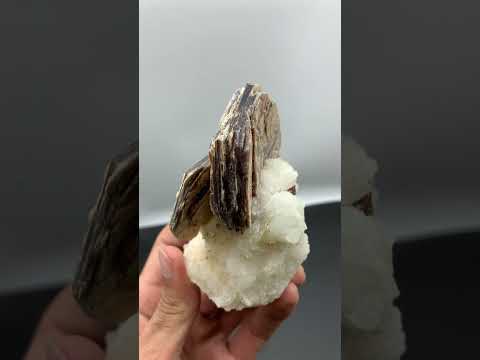


Those sheets are central to muscovite's identity. A crystal can separate into transparent or translucent layers while retaining a broad, reflective surface, creating the familiar stacked appearance often described by collectors as a mica book. Muscovite commonly occurs in granites and granitic pegmatites, where it can grow beside quartz, feldspar, tourmaline, beryl and other minerals. Buyers comparing muscovite with other mineral specimens and crystals should therefore consider both the mica itself and the geological composition of the complete specimen.
Muscovite Mica Books: Why Layered Crystal Structure Defines the Specimen
One of the most attractive forms of muscovite is a well-developed mica book, where numerous parallel sheets remain stacked into a single crystal body. The edges can appear stepped, foliated or slightly irregular while the broad basal surfaces remain smooth and highly reflective. This structure is not accidental separateting after mining; it reflects the way the mica crystal is built at the atomic level.
A thick book is not necessarily better than a thinner one. Collector appeal often depends on whether the layered structure remains coherent, whether the broad faces retain their natural luster, and whether the specimen preserves enough original form to be understood as a crystal rather than simply a loose pile of sheets.
Mica books can also show partial separation along their edges. Minor natural opening between layers can make the structure more visible and attractive, while excessive peeling caused by rough handling can weaken the specimen and remove important surface material. Buyers should distinguish naturally expressive layering from later mechanical deterioration.
Muscovite Cleavage: Why the Mineral separates Into Thin Elastic Sheets
Muscovite has perfect basal cleavage, meaning the crystal separates extremely easily along one structural plane. This is the feature responsible for the classic thin mica sheets that can become nearly transparent when sufficiently fine.
Fresh sheets can bend and return toward their original shape because muscovite has elastic rather than simply flexible tenacity. That behavior distinguishes it from minerals whose thin fragments bend but remain permanently deformed.
Cleavage is scientifically useful but should not invite unnecessary testing on a collector specimen. Repeatedly peeling layers from a complete mica book permanently changes its form and can turn an attractive natural crystal into loose flakes. The best approach is to appreciate the cleavage where it is already naturally visible rather than deliberately separating a preserved specimen.
Muscovite Color: Colorless, Silvery, Cream and Naturally Tinted Crystals
Typical muscovite ranges from colorless and white through silvery-white, pale gray, cream and very light brownish or yellowish tones. Impurities and compositional variation can introduce additional subtle colors, while thin transparent sheets can appear almost glass-like when viewed against light.
Color often changes according to thickness. A thick mica book may appear gray, champagne or slightly smoky from the side while an individual separated edge remains nearly colorless. Reflections from broad cleavage surfaces can also create silver or pearly flashes even when the mineral itself contains little body color.
The strongest specimen therefore does not require dramatic saturation. Muscovite is often most attractive when transparency, luster and layered structure work together, particularly where clean sheets contrast naturally with darker tourmaline or pale feldspar in pegmatite matrix.
Muscovite Luster: Vitreous Faces and Pearly Cleavage Surfaces
Muscovite can show vitreous, silky and especially pearly luster. Broad cleavage surfaces often produce the characteristic pearly reflection associated with mica, changing brightness dramatically when the specimen is tilted beneath light.
This optical quality can make a seemingly pale mineral visually active. A muscovite book may appear subdued from one angle and then flash strongly across an entire basal surface when the viewing direction changes.
Surface preservation matters because scratches, fingerprints, dust and peeling can reduce the clarity of those reflections. Unlike a hard quartz crystal, muscovite is soft enough that unnecessary rubbing can mark the surface relatively easily. Gentle handling helps retain the natural sheen.
Muscovite Crystal Shape: Pseudohexagonal Plates and Complex Stacked Growth
Although muscovite is monoclinic, crystals can appear roughly hexagonal or pseudohexagonal when viewed across broad basal faces. This apparent six-sided outline can be especially noticeable in isolated plates or well-shaped mica books.
Natural crystals can also form rosettes, radiating groups, tabular aggregates and irregular stacked masses. These habits reflect both crystal structure and the amount of space available during growth.
A collector seeking a textbook example may prefer a well-defined plate or book with a clear outline, while another may favor a more sculptural cluster on matrix. Neither form is automatically superior because they preserve different aspects of muscovite's natural development.
Muscovite in Pegmatites: Quartz, Feldspar and Tourmaline Associations
Granitic pegmatites are among the most familiar environments for large muscovite crystals. Slow crystallization and volatile-rich fluids can produce unusually coarse mineral growth, sometimes allowing mica books to reach impressive dimensions.
Muscovite can occur beside quartz and feldspar, while tourmaline, beryl, garnet and other pegmatite minerals may add further interest depending on locality. A pale reflective mica book against blocky feldspar or dark tourmaline can create excellent visual contrast while preserving the geological association.
Matrix should still be judged for stability. Large mica sheets can project from host rock through relatively narrow attachment areas, while feldspar or quartz may contribute substantial weight. A specimen should therefore be lifted from its strongest base rather than by an exposed muscovite plate.
Muscovite Hardness: Why Shiny Sheets Scratch Easily
Muscovite is soft compared with most familiar gem minerals. Its hardness is approximately 2.5 along the cleavage direction, meaning quartz, feldspar and many common collector minerals can scratch exposed sheets easily.
That softness explains why a bright reflective surface can become dull if rubbed repeatedly. It also means collectors should avoid stacking harder specimens directly against muscovite in drawers or storage boxes.
The recommendations under gemstone care provide useful handling principles, although intact mica books need particular protection from pressure on their edges. A broad plate may look substantial while remaining surprisingly easy to separate if bent or struck unfavorably.
Muscovite Transparency: From Clear Sheets to Thick Opaque-Looking Books
Individual muscovite sheets can be highly transparent, which historically made large mica sheets useful where heat-resistant transparent panels were needed. A thick book, however, can look translucent or nearly opaque because numerous layers, internal boundaries and surface reflections reduce the amount of light transmitted through the entire crystal.
This difference means transparency should be evaluated according to the specimen's natural form. A thick collector book is not lower quality simply because it cannot be seen through from side to side.
Clear edges and partially separated sheets can still reveal the mineral's transparency beautifully, while a dense book may be more impressive for size, luster and preserved crystal structure.
Muscovite vs Other Micas: Appearance Alone Does Not Always Identify the Species
Muscovite belongs to the mica group, whose members share strongly layered structures and excellent basal cleavage. Biotite-group micas are typically darker, while lithium-bearing and chromium-bearing micas can introduce additional colors that overlap partly with ordinary muscovite.
Green chromium-rich muscovite is commonly known as fuchsite, while other mica species can be pink, purple, brown, black or pale. Color is therefore useful but not sufficient for exact mica identification.
Crystal chemistry, optical properties and reliable locality information become more important where species-level identification matters. A pale mica is not automatically muscovite solely because it separates into sheets.
Muscovite Natural Crystal vs Loose Mica Flakes
A complete muscovite specimen preserves much more mineralogical information than loose flakes. Crystal shape, book structure, matrix attachment and relationships with associated minerals can all disappear once the specimen has been separate repeatedly.
Loose mica still demonstrates cleavage and transparency, but it serves a different collecting purpose. A preserved book provides a clearer record of how the mineral actually grew.
For this reason, a large intact muscovite should not be peeled simply to produce thinner sheets unless that destructive sampling is genuinely necessary. Keeping the original structure intact usually protects more collector value.
Muscovite Authenticity and Mineral Identification
Muscovite's perfect cleavage and elastic sheets are highly characteristic, but exact identification should still consider color, crystal form, optical behavior and geological setting. Other mica-group minerals can produce similar thin layers and pearly surfaces.
Gandhara Gems' authenticity guarantee provides relevant purchasing context when mineral identity matters. Collectors should also preserve locality labels because pegmatite source information can add meaningful geological context, especially when a specimen contains several associated minerals.
Analytical identification becomes most useful when unusual coloration or composition makes ordinary visual separation unreliable.
Buying Muscovite Minerals Online: Compare Book Structure and Surface Condition
A useful online comparison begins with the overall mica book or crystal form, then considers broad-face luster, color, transparency, edge condition, matrix and actual dimensions. Several viewing angles can reveal whether a thick book remains coherent or has begun separating excessively along its edges.
Close-up photographs should be interpreted alongside measurements because thin plates can appear substantial when photographed directly from above. Depth becomes just as important as width when evaluating the true physical character of a mica book.
The strongest purchase is usually the specimen whose layered structure, reflective surfaces and geological associations remain intact enough to display naturally without requiring additional manipulation.
Muscovite Mineral FAQs
Why does muscovite separate into such thin sheets?
Muscovite has perfect basal cleavage because its crystal structure contains strongly bonded silicate layers separated by weaker connections. The mineral therefore separates easily parallel to those layers, producing very thin sheets. These sheets are flexible and elastic, meaning they can bend and tend to recover their shape when the force is removed.
Is muscovite always colorless or silver?
No. Typical muscovite can be colorless, white, silvery, grayish, cream or lightly tinted by impurities. Certain compositional variations can introduce stronger colors. Thick books also appear darker than individual sheets because multiple layers and reflections reduce transparency.
What is a muscovite mica book?
A mica book is a thick stack of parallel muscovite sheets that remain naturally joined as one crystal body. The appearance resembles the pages of a book, particularly where individual layers begin separating slightly at the edges. Complete books are often attractive collector specimens because they show muscovite's layered structure clearly.
How hard is muscovite?
Muscovite is relatively soft, with hardness around Mohs 2.5 along its basal direction. It can therefore be scratched by many common minerals, including quartz and feldspar. Its broad shiny surfaces should be protected from rubbing and abrasive cleaning even though individual sheets can feel surprisingly resilient when flexed gently.
Should I peel layers from a muscovite specimen?
Peeling a complete collector specimen is generally undesirable because every removed sheet permanently changes the natural form. Muscovite cleavage can already be appreciated from exposed edges and naturally separated layers. Preserving the mica book usually retains more geological and aesthetic information than repeatedly separateting it.
Can muscovite occur with gemstone minerals?
Yes. Muscovite is common in many granitic pegmatites, the same geological environments that can contain tourmaline, beryl, garnet, quartz, feldspar and other minerals. These associations can make matrix specimens particularly appealing when the mica remains well formed and the accompanying minerals are clearly visible.
Choose Muscovite Minerals by Mica Book Structure, Luster and Preservation
Compare the current Muscovite Minerals by layered crystal form, silvery to pearly luster, transparency, edge condition, matrix association and actual dimensions. Give particular attention to intact mica books and clean broad cleavage surfaces because these features reveal the mineral's characteristic structure most clearly. Choose the individual specimen whose natural layering, preservation and geological association best fit your collection and display space.

Recently Viewed Products
Example product title
- $19.99
- $19.99
- Unit price
- / per
Example product title
- $19.99
- $19.99
- Unit price
- / per
Example product title
- $19.99
- $19.99
- Unit price
- / per
Example product title
- $19.99
- $19.99
- Unit price
- / per
Example product title
- $19.99
- $19.99
- Unit price
- / per
Example product title
- $19.99
- $19.99
- Unit price
- / per
Example product title
- $19.99
- $19.99
- Unit price
- / per
Example product title
- $19.99
- $19.99
- Unit price
- / per
Example product title
- $19.99
- $19.99
- Unit price
- / per
Example product title
- $19.99
- $19.99
- Unit price
- / per
- Choosing a selection results in a full page refresh.


