


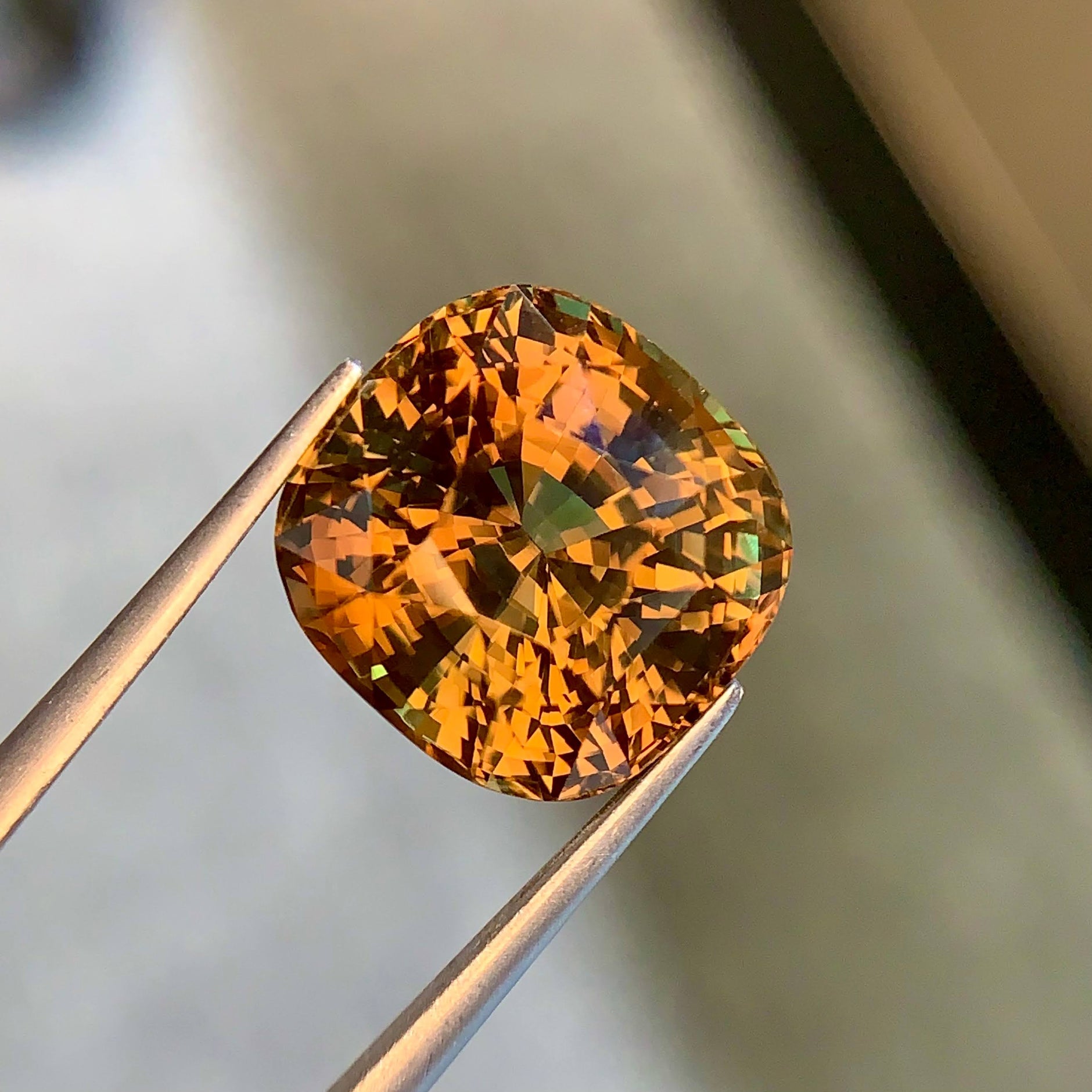


Oval Loose Gemstones: Buyer Guide
Oval loose gemstones are faceted stones with elongated, smoothly curved outlines that are sold before being mounted into jewelry. Their proportions and faceting vary considerably, even among gemstones described by the same commercial cut name. A natural oval sapphire may have brilliant-style facets that create numerous flashes, while an oval spinel can have broad step facets producing a more structured reflection pattern. Aquamarine, garnet, tourmaline, zircon, and other minerals introduce further variations in color, transparency, brilliance, and physical dimensions.
An oval shape can be attractive because it combines a balanced silhouette with flexibility in cutting. However, the outline alone provides very little information about the stone's actual quality. Two gemstones with similar face-up dimensions can differ substantially in cutting depth, bodycolor, visible inclusions, and optical performance. One may remain bright through the center as it moves, while another shows a persistent dark bow tie or a transparent window.
Buying an oval loose gemstone allows the full stone to be inspected before part of the girdle and pavilion becomes concealed. The most useful comparison involves the relationship between length, width, and depth, the arrangement of the facets, the visibility of any inclusions, and how the gemstone's natural color behaves under ordinary lighting. A sound purchasing decision begins with these characteristics rather than assuming that a particular weight, clarity label, or cutting style guarantees beauty.

Two oval gemstones can have very different cutting styles
The word oval describes the outline, not the complete arrangement of facets.
A conventional oval brilliant generally uses facets designed to create numerous changing reflections. This can produce an attractive pattern of scintillation when the pavilion and crown are appropriately proportioned for the mineral.
A step-cut oval creates a different effect. Its broader facets can produce orderly reflections and emphasize transparency or saturated color. The appearance may be more restrained than that of a brilliant-style oval, but it can be equally attractive when the cutting is well executed.
Mixed and modified oval designs offer additional variations. Some use brilliant-style crowns with different pavilion arrangements, while others employ intricate facet patterns selected for a particular piece of rough material.
These distinctions matter because buyers often compare stones as if every oval should display the same sparkle. A fine step-cut spinel should not be judged exclusively against the number of flashes produced by a brilliant-cut zircon. Their optical properties and the intended visual effects differ.
The important question is whether the chosen facet arrangement complements the individual gemstone's color and produces appealing reflections rather than whether it conforms to one familiar commercial style.
Compare actual dimensions before comparing carat weights
Carat weight measures mass. It does not establish the physical area visible when looking directly at a gemstone.
Different minerals have different densities, while cutting depth determines how much weight lies beneath the girdle. This means a two-carat sapphire may have different dimensions from a two-carat aquamarine, even when both are oval.
Three currently listed gemstones illustrate how these factors interact.
| Natural oval gemstone | Weight | Published dimensions | Length-to-width ratio |
|---|---|---|---|
| Blue spinel, Myanmar, step oval | 2.45 ct | 9.2 × 7.0 × 4.8 mm | 1.31 |
| Blue aquamarine, African origin listed | 4.24 ct | 13.4 × 9.7 × 5.9 mm | 1.38 |
| Hot-pink tourmaline, Nigeria | 4.80 ct | 11.21 × 9.71 × 6.57 mm | 1.15 |
The measurements show that greater weight does not necessarily produce a proportionally longer face-up outline. The 4.80-carat tourmaline is much broader relative to its length than the 4.24-carat aquamarine.
The difference is important because a buyer may prefer a full, rounded oval over a markedly elongated shape. The most desirable dimensions depend on personal preference and the intended use of the stone, not simply the longest outline available at a particular weight.
These three gemstones also have different optical properties and commercial values. Their dimensions provide useful physical comparisons, but their weights should not be treated as interchangeable measures of beauty or worth.
What a length-to-width ratio can tell you
The length-to-width ratio is a simple way to describe the elongation of an oval.
It is calculated by dividing the longer face-up measurement by the shorter one.
Length-to-width ratio = Length ÷ Width
An oval measuring 10 × 8 mm has a ratio of 1.25, producing a broad outline. An oval measuring 12 × 8 mm has a ratio of 1.50 and will appear noticeably more elongated.
There is no universal ratio that defines the best oval loose gemstone. Buyers differ in their preferences, and a stone's original crystal shape can influence the proportions a cutter chooses.
The curve of the shoulders also matters. Two stones with the same ratio may look different when one has broad, rounded ends and the other narrows more sharply near its tips.
Symmetry should be assessed independently. A gemstone may have an attractive ratio while one side is noticeably flatter or fuller than the other.
The ratio is therefore a useful descriptive measurement, not a substitute for examining the complete face-up outline.
The bow tie is a matter of degree, not merely presence
Many elongated faceted gemstones display darker reflections across their centers, a pattern commonly called the bow-tie effect.
In an oval, the effect can result from the relationship between the pavilion facets, cutting depth, light sources, and viewing position. In some strongly pleochroic gemstones, cutting orientation can also create pronounced color or contrast differences across the center.
A subtle bow tie may contribute to the stone's visual character by creating contrast. The concern is a broad, persistent dark band that obscures a significant portion of the natural color.
The bow tie should be assessed through movement. As the gemstone rotates or tilts, different facets should return light toward the viewer, causing the bright and dark regions to change.
A single photograph cannot reliably establish whether an oval has a distracting bow tie. The stone may have been photographed at an angle that minimizes darkness or under lighting conditions that make most facets appear bright.
An ordinary-light video provides a more useful impression. The buyer can assess whether the center becomes lively at different angles or remains predominantly dark.
For a highly saturated sapphire, garnet, or tourmaline, this evaluation can be particularly important because the mineral's bodycolor may deepen the visual effect.
Windowing creates a different problem
A bow tie is not the same as windowing.
Windowing occurs when an area of the gemstone permits light to pass through rather than returning sufficient light toward the observer. The result can appear as a pale or transparent region, often near the center.
A shallow pavilion can contribute to windowing, although the correct cutting proportions depend on the mineral's refractive properties.
In a pale aquamarine, a prominent window can make the gemstone look almost colorless through its table. A red garnet or pink tourmaline may show a weaker central color compared with its surrounding facets.
The visual effect can sometimes be examined by placing the loose stone above a neutral patterned surface. If the background becomes conspicuously visible through the center while the surrounding facets remain reflective, windowing may be present.
However, not every transparent area is equally significant. Some cuts deliberately use open optical effects, and small windows may be commercially acceptable when the gemstone has otherwise attractive characteristics.
The buying decision should consider whether the window materially detracts from the stone's face-up appearance and whether the asking price reflects that compromise.
A 4.24-carat aquamarine shows why depth needs context
The 4.24-carat natural blue oval aquamarine from Africa measures 13.4 × 9.7 × 5.9 mm, with VVS clarity and no treatment stated in its specifications.
The published measurements describe a noticeably elongated gemstone with a relatively broad visible surface. However, measurements alone cannot establish whether the pavilion has been cut optimally.
Aquamarine is often available with attractive transparency, making cutting quality especially important. A pale stone may look bright yet fail to display enough blue color, while a stone cut too shallowly can develop an obvious window.
A deeper design may strengthen apparent color in some examples, but unnecessary depth can preserve weight without creating proportionally greater visual size.
The buyer should examine the stone's bodycolor, central light return, and facet reflections rather than assuming that its VVS description establishes superior overall quality.
Aquamarine also illustrates why cross-species comparisons require care. A sapphire of the same carat weight would not necessarily have the same face-up dimensions because the two minerals have different densities.
The most important comparison is with other aquamarines of reasonably similar color, clarity, and size, allowing differences in cutting to be judged meaningfully.
A step-cut spinel changes what buyers should look for
Not every oval gemstone is intended to display the same rapid scintillation.
The 2.45-carat natural bright-blue spinel from Myanmar is described as a step oval, with dimensions of 9.2 × 7.0 × 4.8 mm, eye-clean clarity, and no treatment stated.
A step-cut oval needs a different visual assessment from a conventional oval brilliant. Its broader facets may emphasize structured reflections, so the buyer should look for attractive polish, alignment, transparency, and balanced light return.
Large internal features can be more conspicuous beneath broad facets. A dark inclusion near the center may distract from the cutting pattern, while a small enclosed crystal near the girdle may have little face-up impact.
The cutter's control over the pavilion is particularly important. A stone with an orderly facet pattern can still suffer from windowing or excessive darkness if the proportions are unsuitable.
Blue spinel should also be evaluated for color tone. A saturated stone can be attractive, but substantial darkness may obscure the visual pattern under ordinary indoor lighting.
The value of this example lies partly in showing that an oval can have a distinctive cutting style rather than conforming to the brilliant-facet appearance often associated with the shape.

Pink tourmaline adds color orientation to the evaluation
Tourmaline creates another set of buying considerations because the mineral can be strongly pleochroic.
A gemstone may appear differently colored or differently saturated depending on the direction of observation. The cutter must choose an orientation that produces an attractive face-up appearance while balancing weight retention and the natural shape of the rough crystal.
The 4.80-carat natural hot-pink oval tourmaline from Nigeria measures 11.21 × 9.71 × 6.57 mm, with a published VVS clarity description and no treatment stated.
Its comparatively broad proportions produce a different shape from the elongated aquamarine discussed earlier. The actual color also becomes a central part of the buying decision because vivid pink tourmaline should remain attractive across the oval rather than displaying unwanted darkness or uneven saturation.
Color zoning is not automatically undesirable. Some tourmalines are deliberately cut to show multiple colors, creating distinctive patterns that would be impossible in uniformly colored material.
A buyer should nevertheless distinguish intentional color variation from an unattractive result caused by cutting orientation.
This example also demonstrates why the apparent size and quality of two gemstones cannot be determined by comparing their carat weights alone. Mineral identity, bodycolor, optical properties, and cutting proportions all contribute to their individuality.
Garnet and sapphire introduce their own color challenges
Garnet and sapphire illustrate how the same oval outline can require different cutting decisions.
Certain red garnets have a relatively dark bodycolor. If the pavilion is too deep or the material absorbs excessive light, the gemstone may appear nearly black under ordinary indoor conditions.
A slightly lighter garnet with lively reflections may therefore look more attractive than a heavier example whose rich red color is visible only under strong lighting.
Sapphire presents another issue through natural color zoning and pleochroism. A cutter may orient the stone to emphasize a particular hue or bring concentrated color beneath the table.
A bicolor or parti-colored sapphire can be striking when those regions remain attractive face-up. However, buyers should consider whether the distribution enhances the stone's appearance or creates an unwanted division between its two halves.
The availability of natural garnets in different colors and cuts also demonstrates why a species-level description is not enough to evaluate a particular gemstone's optical performance.
The strongest oval should be judged according to its actual mineral variety and individual color, not simply whether it belongs to a familiar gemstone category.
Precision workmanship should make a visible difference
Fine cutting involves more than selecting an attractive shape.
Facet junctions should be clean, polish should be appropriate to the material, and the crown and pavilion should work together to produce balanced reflections. A table that is noticeably off-center or shoulders that are visibly uneven may detract from the finished appearance.
However, natural colored gemstones are sometimes cut to preserve desirable color or avoid significant inclusions. Minor irregularities can be acceptable when they do not materially affect beauty.
A precision-cut label may reflect additional design work, carefully controlled angles, or unusually refined polish. It can justify a premium when the differences contribute to optical quality or visual appeal.
The comparison between precision cutting and conventional gemstone workmanship ultimately depends on the individual stones. A simple commercial oval can be beautiful, while a technically elaborate design may still look unattractive if its proportions are poorly suited to the mineral.
A loupe can reveal fine polishing lines or irregular facet junctions, but the unaided face-up appearance remains important.
Buyers should pay for craftsmanship that produces a meaningful improvement, not merely for terminology that suggests greater sophistication.
The same price per carat can buy very different quality
Price per carat is a useful calculation, but it cannot evaluate gemstones independently of their mineral species and individual characteristics.
The formula is straightforward:
Price per carat = Total asking price ÷ Carat weight
The three examined oval gemstones have different asking prices in the verified listings.
| Natural gemstone | Weight | Listed price | Approximate price per carat |
|---|---|---|---|
| Blue aquamarine | 4.24 ct | $450 | $106 |
| Hot-pink tourmaline | 4.80 ct | $840 | $175 |
| Blue step-cut spinel | 2.45 ct | $1,098 | $448 |
These figures are individual retail asking prices, not market-wide price ranges. They can change, and the apparent differences should not be interpreted as premiums caused by the oval shape alone.
The gemstones have different colors, optical properties, rarity characteristics, treatments, and commercial markets.
The spinel's higher listed price per carat does not prove superior cutting, just as the aquamarine's lower price per carat does not establish better value.
A useful comparison begins within the same mineral species or variety, using stones with similar color, size, clarity, and treatment information. Differences in cutting and price then become easier to interpret.
For a buyer working within a fixed budget, a somewhat smaller gemstone with attractive proportions can be a more satisfying choice than a heavier example selected primarily because its price per carat looks low.
How photographs can distort an oval's apparent proportions
A gemstone photographed from even a slight angle may appear longer, narrower, or less symmetrical than it does when viewed directly from above.
Strong reflections can also conceal the underlying facet pattern. A pale stone photographed against a dark background may appear more saturated, while a dark sapphire under intense illumination can look brighter than it will in ordinary room light.
The most useful images show the actual gemstone in a clear face-up position, accompanied by angled views and a side profile.
A moving video allows the buyer to inspect the bow tie, central brightness, and whether the two ends display balanced reflections.
Measurements provide another reference. When a listing says a stone is 11 × 8 mm, the buyer should understand that its actual shoulder curvature and depth may differ from those of another oval with the same nominal dimensions.
Photographs and specifications should agree, but they serve different purposes. Images show appearance, while measurements describe physical size and laboratory documentation may establish mineral identity or certain treatments.
A well-supported online purchase uses all three kinds of evidence rather than trusting a single attractive photograph.
Clarity descriptions need to be interpreted by mineral species
Natural gemstones differ in their typical inclusion characteristics, making one universal clarity expectation unsuitable.
Some aquamarines and spinels are available with excellent transparency. Other gem varieties may contain more visible inclusions that are accepted commercially, particularly when their color or rarity is desirable.
A VVS or VS designation in a product listing should be understood in the context of the seller's grading terminology rather than assumed to represent an independent universal colored-stone standard.
The location of inclusions matters as well. A small enclosed crystal near the girdle may have limited visual impact, while a dark inclusion beneath the table can attract attention.
Surface-reaching fractures deserve separate consideration because they may influence physical stability or future setting requirements.
A gemstone with fewer visible inclusions is not automatically better if its color is weak, its proportions are poor, or its cutting produces excessive darkness.
The buyer should decide whether internal features affect actual beauty or physical condition instead of ranking stones solely by clarity labels.
Natural origin and treatment disclosures affect the comparison
The oval shape does not establish whether the mineral formed naturally or whether it has been enhanced.
Natural sapphire may be heated, while some tourmalines receive treatments that affect their color. Other gemstone varieties have different enhancement possibilities.
A claim of untreated status should be evaluated separately from the assertion that a gemstone is natural.
An independent laboratory report can be useful when natural identity, treatment status, or geographic origin has a substantial influence on the asking price.
However, a laboratory identification report does not automatically establish that an oval is beautifully cut or correctly priced.
The buyer should also distinguish between the geographic locality stated in a listing and a scientifically established origin determination. Not every gemstone can have its precise source established reliably through laboratory examination.
Cutting quality, physical measurements, and appearance remain separate considerations, even when identity and treatment information are documented.
Before the loose gemstone becomes part of another purchase
A gemstone intended for jewelry may pass from the seller to a buyer and then to a jeweler. Each step makes accurate identification and condition records important.
The buyer should inspect the stone on delivery, comparing its dimensions, color, inclusions, and physical condition with the listing and any supplied report.
The jeweler should then examine the girdle, pavilion depth, and any fractures before confirming the mounting design. Two oval gemstones with similar nominal dimensions may still require different settings.
Any important discrepancy should be addressed before the stone is polished, recut, or permanently mounted.
Alterations can affect return eligibility, and a gemstone whose condition changes during setting may be more difficult to evaluate against its original listing.
Taking time to establish the quality of the loose stone before further work begins helps preserve both its beauty and its value.
Conclusion
Oval loose gemstones can differ dramatically in color, cutting design, physical dimensions, and optical appearance even when their outlines seem similar. A brilliant-cut aquamarine, step-cut spinel, and vividly colored tourmaline should not be judged by exactly the same visual expectations. Their value depends on the relationship between mineral characteristics, color, clarity, cutting workmanship, and the individual stone's appeal.
The strongest buying decision compares actual face-up beauty with accurate measurements and reliable disclosures. An attractive oval should display balanced proportions, suitable light return, and color that remains pleasing outside concentrated studio lighting. Natural loose gemstones can then be compared by species, cut, clarity, dimensions, carat weight, and price without treating the oval label as a substitute for quality.

Frequently Asked Questions
What should I check first when buying an oval loose gemstone?
Begin with its actual face-up appearance. The outline should look balanced, with smoothly curved shoulders and ends that appear reasonably symmetrical. Its color should remain attractive across the stone, and the central reflections should not be dominated by a persistent dark bow tie or a large transparent window. After evaluating the appearance, compare length, width, depth, clarity, treatment information, and price. The stone's individual characteristics are more meaningful than the oval shape or carat weight considered alone.
What is the ideal length-to-width ratio for an oval gemstone?
There is no universal ideal ratio for every colored gemstone. A ratio around 1.25 produces a broad oval, while a ratio around 1.50 creates a more elongated appearance. Both can be attractive when the outline and faceting are balanced. Shoulder curvature also matters because two gemstones with identical ratios can have noticeably different silhouettes. Buyers should select proportions according to their preferences and intended jewelry while ensuring that the cutting produces good color and brightness.
Are all oval gemstones brilliant cut?
No. Oval describes the external outline, while brilliant, step, mixed, and modified cuts describe different facet arrangements. An oval brilliant generally produces numerous changing reflections, while a step-cut oval can display broader, more organized flashes. The actual effect also depends on the mineral's optical properties and the quality of the cutting. A buyer should examine the gemstone's facet pattern rather than assume the shape guarantees a particular type of sparkle.
Is a bow tie always undesirable in an oval gemstone?
No. Some darker central contrast is normal and can contribute to attractive scintillation. A bow tie becomes a concern when a wide, persistent dark band obscures a substantial portion of the gemstone's color or brightness. The effect depends on cutting proportions, mineral characteristics, and lighting. A moving video is useful because it shows whether the dark reflections change as the stone rotates. The visual impact is more important than simply identifying whether a bow tie exists.
Why can two oval gemstones of the same weight look different in size?
Carat weight measures mass rather than physical dimensions. Different minerals have different densities, so stones of identical weight may occupy different volumes. Cutting proportions also influence apparent size because a deep pavilion can retain significant weight beneath the visible surface. A shallower oval may look broader but could suffer from windowing when its angles are unsuitable. The buyer should compare actual length, width, depth, and light return rather than treating equal weight as proof of equal visible size.
Can an oval gemstone have excellent clarity but poor cutting?
Yes. A gemstone may be eye-clean or have a high seller-assigned clarity description while displaying an obvious window, excessive darkness, weak polish, or uneven facets. Clarity describes internal or surface-reaching features rather than the quality of the cutting. An attractive gem requires both suitable material and workmanship that complements its color and optical properties. A slightly included stone with excellent color and cutting may be more desirable than a cleaner example whose proportions produce unattractive reflections.
Is a step-cut oval spinel less valuable than a brilliant-cut oval spinel?
Not automatically. Value depends on the gemstone's color, clarity, size, treatments, rarity, and the quality of its cutting. A well-executed step cut can be highly attractive when its broad reflections and geometric pattern complement the stone's color. A brilliant-style design may create more frequent flashes, but that does not automatically make it superior. A fair comparison should involve actual spinels of similar material quality rather than assuming that one facet arrangement always commands a premium.
How can I compare oval gemstones from different mineral species?
Start by identifying the mineral species and understanding its typical color, optical characteristics, and physical properties. Then compare the actual face-up appearance, including brightness, color distribution, windowing, and facet workmanship. Carat weight and price per carat should be interpreted cautiously because different species have different densities, rarity, and market demand. Treatment disclosures and documentation also matter. Comparing individual stones within each mineral category generally provides a more meaningful indication of quality and price than ranking unrelated gems by weight alone.


